Why Payload Matters More Than Purchase Price
For commercial fleet operators, a truck's earning capacity is determined by one number: legal payload capacity. Every kilogram of body weight is a kilogram of cargo you cannot carry. Over the lifetime of a commercial vehicle (typically 8-12 years, 200,000-500,000 km), the payload difference between a heavy steel body and a lightweight composite body can represent tens of thousands of dollars in additional revenue.

Consider a simple calculation for a 4.5-tonne GVW (Gross Vehicle Weight) truck:
- Steel body weight: 600 kg (body + frame)
- Composite body weight: 250 kg (body + aluminum frame)
- Weight saved: 350 kg
- Additional payload per trip: 350 kg
- Trips per year: 500 (2 trips/day x 250 working days)
- Freight rate: $0.10/kg
- Additional annual revenue: $17,500
This is why composite truck bodies are growing rapidly in commercial fleets — the economics are overwhelming once fleet managers look beyond the purchase price.
Composite Panel Options for Truck Bodies
We produce three primary panel types for truck body construction, each optimized for a specific body zone:
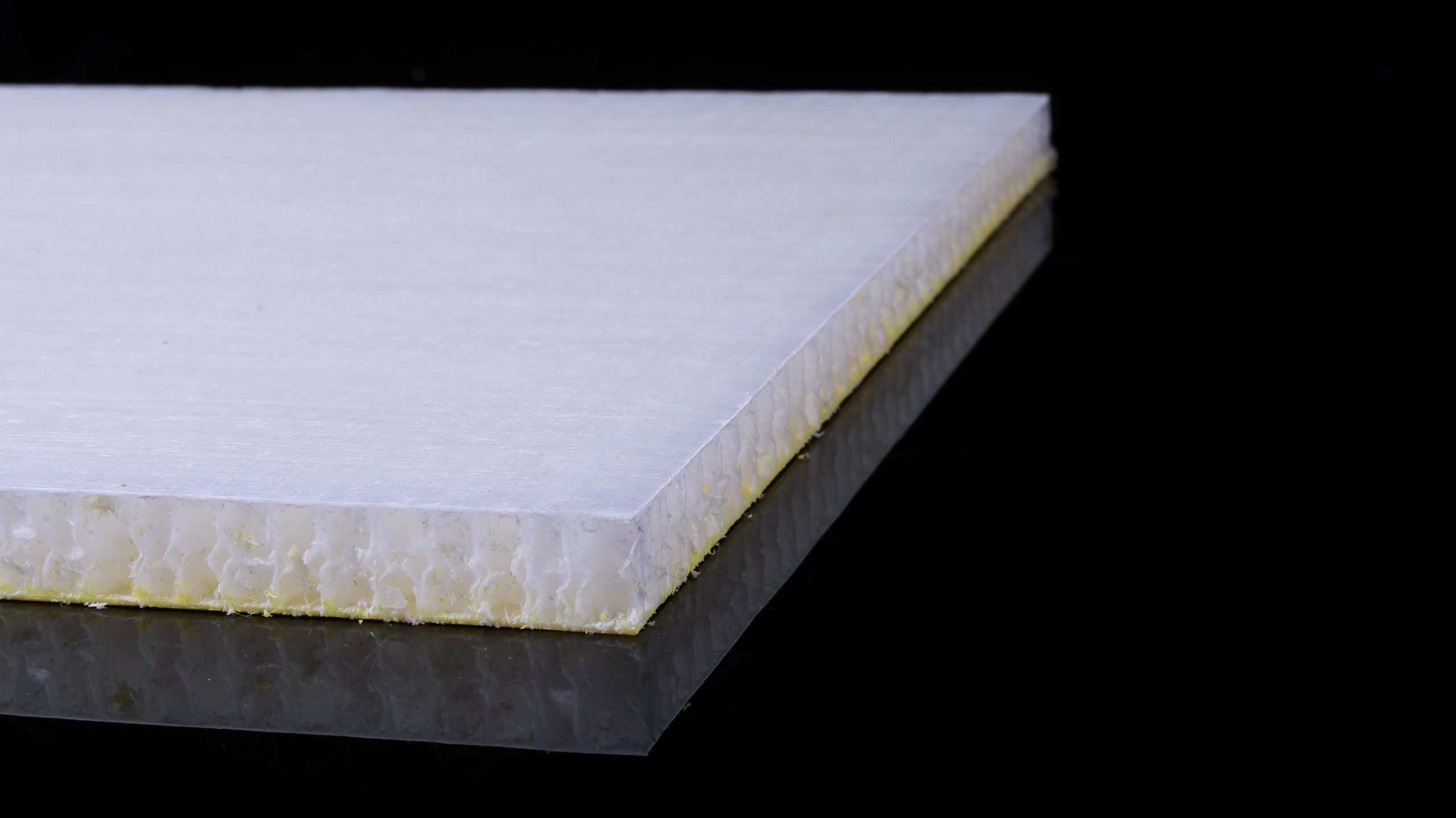
PP Honeycomb Panels (Sidewalls & Roof)
The workhorse of our truck body system. These panels use glass fiber reinforced PP face sheets over PP honeycomb core, providing high stiffness at minimal weight.- Panel thickness: 25-30mm
- Areal weight: 3.0-4.5 kg/m2
- Face sheets: Continuous glass fiber reinforced PP (CFRT) or PET non-woven
- Surface finish: White (clean appearance), textured (anti-scuff), or custom color
CFRT Floor Panels
Truck floors endure the harshest conditions: forklift traffic, cargo impacts, constant loading/unloading, and exposure to water and chemicals. Our CFRT floor panels are specifically engineered for this abuse:- Panel thickness: 25-35mm (depending on load rating)
- Areal weight: 4.0-6.0 kg/m2
- Face sheets: Black anti-slip CFRT with 1.0-1.5mm continuous glass fiber reinforcement
- Compressive strength: 2.0-3.0 MPa (supports forklift point loads with load-spreading pads)
MPP Insulation Panels (Refrigerated Bodies)
For refrigerated truck bodies, thermal insulation is as important as structural performance. Our MPP (Micro-foamed Polypropylene) panels use supercritical CO2 technology to create a micro-cellular foam core:- Panel thickness: 40-60mm
- Thermal conductivity: 0.035-0.040 W/mK (comparable to XPS foam)
- Operating temperature: -30 to +50 degrees C (cold chain compatible)
- Face sheets: CFRT with sealed edges for vapor barrier
CKD Modular Truck Body Design
Our CKD (Completely Knocked Down) truck body system is designed for global export. Instead of shipping assembled bodies (expensive and logistically difficult), we ship flat-packed kits that are assembled on-site.
Kit Contents
A typical CKD dry freight truck body kit includes:Assembly Process
Assembly requires 2-3 workers with basic tools (wrenches, drills, rivet guns) and takes 4-8 hours:No welding, no painting, no specialized equipment required.
CKD Shipping Advantages
| Metric | Assembled Body (Steel) | CKD Kit (Composite) |
|---|---|---|
| Bodies per 20ft container | 1 | 4-6 |
| Shipping cost per body | $2,500-4,000 | $500-800 |
| Import duty rate (many markets) | Finished goods rate | CKD rate (lower) |
| Assembly required | None | 4-8 hours |
| Local labor benefit | None | Creates local jobs |
The 4-6x improvement in container utilization is the single biggest cost advantage of our CKD system. For an order of 100 truck bodies, the shipping savings alone ($150,000-300,000) often exceed the incremental material cost of composite panels over steel.
Standard CKD Models
We offer five standard truck body configurations:
| Model | Internal Dimensions | Volume | Panel Type | Door Configuration |
|---|---|---|---|---|
| LS300 | 3480 x 2200 x 2200 mm | 14.45 m3 | Single-side PET PP Honeycomb | Side double door |
| LS400-S | 4200 x 2200 x 2095 mm | 17.68 m3 | Single-side PET PP Honeycomb | Side single door |
| LS400-D | 4200 x 2200 x 2095 mm | 17.65 m3 | Single-side PET PP Honeycomb | Side double door |
| LS450 | 4850 x 2200 x 2400 mm | 23.55 m3 | Single-side PET PP Honeycomb | Side double door |
| 4.5T Reefer | 4129 x 2139 x 2077 mm | 12.58 + 1.2 m3 | Double-side PET MPP Foam | Rear + side |
Custom dimensions are available for OEM orders above 20 units.
ROI Analysis for Fleet Operators
Scenario: 20-Truck Fleet Upgrade
Current situation: 20 trucks with steel bodies (600 kg each), operating 250 days/year, 2 trips/day, average 300 km/day. Upgrade option: Replace with composite CKD bodies (250 kg each) at end of current body life.| Metric | Steel Bodies (current) | Composite Bodies (upgrade) | Difference |
|---|---|---|---|
| Body weight per truck | 600 kg | 250 kg | -350 kg |
| Additional payload per truck | — | +350 kg | +350 kg/truck |
| Fuel saving per truck per year | — | 1,500-2,500 liters | -$2,250-$3,750 |
| Additional cargo revenue per truck | — | +$17,500/year | +$17,500/year |
| Body purchase cost | $3,000 | $5,500 | +$2,500/truck |
| Maintenance cost (annual) | $400 (rust repair, repaint) | $50 (none needed) | -$350/year |
| Body lifespan | 5-8 years | 12-15+ years | 2x longer |
These numbers assume full utilization of the weight savings — which depends on the cargo type. For dense cargo (liquids, metals, packaged goods), the full 350 kg payload increase is usable. For volumetric cargo (textiles, electronics, furniture), the payload increase may not be fully realized because the body fills by volume before reaching the weight limit.
Frequently Asked Questions
Can composite truck bodies handle forklift loading?
Yes, with proper floor panel specification. Our CFRT floor panels are rated for forklift loading with standard load-spreading plates. For heavy forklift applications (3+ tonne forklifts with narrow tires), we recommend our 35mm heavy-duty floor panels with 6mm cell core. The key is distributing the point load through appropriate floor thickness and core density.
What is the warranty on CKD composite truck bodies?
We provide a 5-year structural warranty on our CKD truck body panels against manufacturing defects. Panels are guaranteed against delamination, core collapse, and face sheet separation under normal commercial use. The warranty does not cover impact damage from accidents, overloading beyond rated capacity, or modifications not approved by HOTECH.
Are composite truck bodies repairable after accidents?
Yes. Minor damage (scratches, dents, small punctures) is repaired with PP welding equipment — a process similar to automotive plastic bumper repair, taking 30-60 minutes per repair. For major panel damage, individual panels can be replaced without disassembling the entire body. This is a significant advantage over steel bodies, where welding repairs require painting and anti-corrosion treatment.
Do you provide chassis mounting design support?
Yes. Our engineering team provides mounting bracket designs for common chassis types (Isuzu, Hino, Foton, Tata, JAC, etc.). We supply CAD drawings of the body-to-chassis interface, including mounting point locations, bolt patterns, and recommended fastener specifications. For non-standard chassis, we work with your engineering team to develop a custom mounting solution.
Can the composite body be painted to match fleet branding?
While painting is possible (with appropriate primer), our panels can also be produced in custom colors — white, gray, or any RAL color — eliminating the need for painting entirely. For fleet branding, we recommend vinyl wrapping, which works excellently on the smooth panel surface and can be changed when the brand identity updates.