
Why Carbon Fiber Honeycomb Panels?
When weight reduction is not just a preference but a competitive requirement, carbon fiber honeycomb panels are the answer. By combining ultra-stiff carbon fiber face sheets with a lightweight honeycomb core, these sandwich panels achieve specific stiffness values that no other material system can match.

A carbon fiber honeycomb panel weighing just 2-4 kg/m2 can replace aluminum panels weighing 8-12 kg/m2 with equal or superior stiffness. In applications like motorsport bodywork, drone structures, marine decking, and premium RV components, this weight advantage translates directly to performance, fuel efficiency, or payload capacity.
At HOTECH, we manufacture carbon fiber honeycomb panels using our PP honeycomb core combined with carbon fiber face sheets. This thermoplastic-core approach offers a cost-effective alternative to traditional aerospace-grade panels using Nomex or aluminum honeycomb cores — while maintaining full recyclability.
Understanding the Sandwich Panel Structure
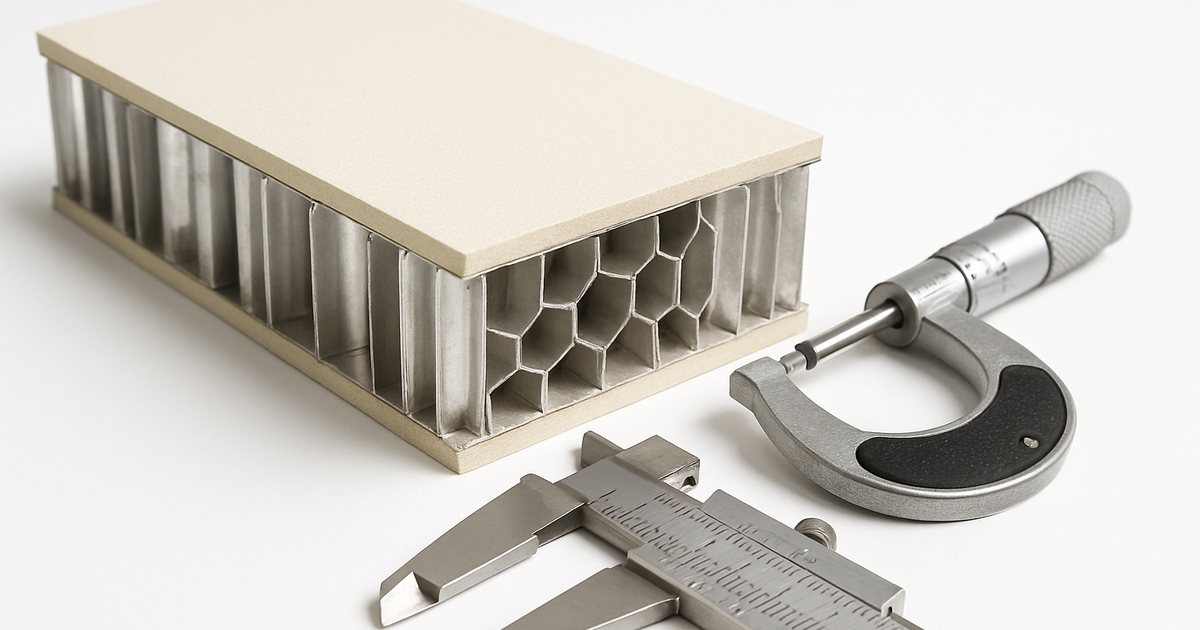
A carbon fiber honeycomb panel consists of three components:
Carbon Fiber Face Sheets (Skins)
The face sheets carry the bending loads. Carbon fiber fabric — typically woven in twill (2x2) or plain weave patterns — is consolidated with a resin matrix to form thin, extremely stiff skins. The fiber orientation (0/90 degree, plus/minus 45 degree, or quasi-isotropic layup) determines the directional strength properties. Typical carbon fiber face sheet properties:- Tensile Strength: 600-800 MPa (woven fabric composite)
- Tensile Modulus: 50-70 GPa (woven fabric composite)
- Density: 1.55-1.60 g/cm3
- Thickness per ply: 0.2-0.3mm
Honeycomb Core
The core separates the face sheets, creating the "I-beam effect" that gives sandwich panels their extraordinary stiffness. Common core options include:| Core Type | Density (kg/m3) | Shear Strength (MPa) | Typical Use | Cost Level |
|---|---|---|---|---|
| PP Honeycomb | 60-120 | 0.6-1.5 | General industrial, automotive | Low |
| Aluminum Honeycomb | 30-130 | 1.0-4.5 | Aerospace, defense | High |
| Nomex (Aramid) Honeycomb | 29-128 | 0.9-3.5 | Aerospace, racing | Very High |
| PET Foam | 60-200 | 0.4-1.2 | Marine, wind energy | Medium |
Our PP honeycomb core offers the best cost-performance ratio for most industrial applications. For applications requiring higher operating temperatures (above 80 degrees C) or aerospace-grade certification, we can source aluminum or Nomex cores.
Adhesive Bond Line
The bond between face sheets and core is critical. In thermoset systems, epoxy film adhesive is used. In our thermoplastic system, the PP honeycomb core is thermally bonded to the carbon fiber skins using a PP-compatible adhesive layer, creating a strong mechanical bond.Mechanical Performance Comparison
To illustrate the advantage of carbon fiber honeycomb panels, here is a comparison at equal panel thickness (20mm):
| Property | CF/PP Honeycomb (20mm) | Aluminum Sheet (3mm) | Steel Sheet (2mm) | Solid Carbon Fiber (3mm) |
|---|---|---|---|---|
| Areal Weight | 2.5 kg/m2 | 8.1 kg/m2 | 15.7 kg/m2 | 4.7 kg/m2 |
| Flexural Rigidity (EI/b) | 850 N-m | 250 N-m | 530 N-m | 120 N-m |
| Specific Stiffness | 340 | 31 | 34 | 26 |
| Panel Cost (relative) | 3x | 1x | 0.5x | 8x |
The key number is specific stiffness (flexural rigidity divided by areal weight). The carbon fiber honeycomb panel achieves specific stiffness approximately 10 times higher than aluminum and solid carbon fiber plate. This is the fundamental reason sandwich construction exists — it maximizes stiffness per unit weight.
Note that a solid 3mm carbon fiber plate is actually less stiff per unit weight than the sandwich panel because it lacks the "I-beam effect" of the separated face sheets. The honeycomb core is what makes the difference.
Manufacturing Methods
We produce carbon fiber honeycomb panels through two primary methods:
Method 1: Vacuum Bag / Autoclave
For maximum quality and void-free laminates. Pre-impregnated (prepreg) carbon fiber fabric is laid up on both sides of the honeycomb core in a mold. The assembly is vacuum-bagged and cured at 120-180 degrees C (depending on resin system) under controlled pressure. This method produces aerospace-quality panels with less than 1% void content. Best for: Racing components, aerospace structures, high-end marine parts.Method 2: Thermal Press Lamination
For cost-effective high-volume production. Dry carbon fiber fabric is pre-consolidated with thermoplastic resin (PP or PA), then thermally bonded to the PP honeycomb core in a continuous press. This method is faster (minutes vs. hours), requires no autoclave, and produces fully recyclable panels. Best for: Automotive components, industrial panels, architectural elements, OEM production runs.Our Tongxiang factory uses Method 2 for most production, achieving panel-to-panel consistency with cycle times under 15 minutes.
Application Sectors
Motorsport and Racing
Carbon fiber honeycomb panels are standard in Formula racing car bodywork, endurance racing aerodynamic elements, and performance vehicle body panels. Weight savings of 5-10 kg per panel directly improve lap times.Marine and Boatbuilding
Deck panels, cabin structures, and hull reinforcements in high-performance boats and yachts. The combination of light weight, high stiffness, and water resistance makes carbon fiber honeycomb panels ideal for marine construction.Premium RV and Campervan
The high-end RV segment is adopting carbon fiber honeycomb panels for roof panels and structural elements where weight savings improve fuel economy and allow additional payload for water tanks, batteries, and living equipment.Industrial Equipment
Robotic arm panels, machine covers, conveyor system components, and equipment enclosures that require high stiffness at low weight. Carbon fiber honeycomb panels reduce inertia in moving systems, allowing faster operation and lower energy consumption.Architecture and Interior Design
Lightweight wall panels, furniture, and decorative elements. Carbon fiber's distinctive woven appearance has become a design feature in premium commercial interiors. When combined with honeycomb core, panels of 3 meters or more can be handled by a single person.Frequently Asked Questions
What is the maximum panel size you can produce?
Our standard production width is up to 1,500mm, with lengths up to 6,000mm. For wider panels, we can produce sub-panels and join them with bonded overlap joints. Custom dimensions are available for OEM orders — contact us with your specific requirements.
Can carbon fiber honeycomb panels be painted or coated?
Yes. For aesthetic applications, panels can be clear-coated to show the carbon fiber weave pattern, or painted with standard automotive paint systems. Surface preparation (light sanding + primer) ensures proper paint adhesion. We can also supply panels with pre-applied gel coat in any RAL color.
How do carbon fiber honeycomb panels handle impact?
The face sheets resist penetration while the honeycomb core absorbs energy through progressive cell crushing. For low-energy impacts (drops, minor collisions), the panel may show cosmetic damage on the face sheet but the structural integrity of the core is preserved. For high-energy impact applications, we can specify thicker face sheets or impact-resistant hybrid layups (carbon/aramid).
Are these panels suitable for outdoor use?
Carbon fiber is inherently UV-stable, but the resin matrix requires protection. Our panels are supplied with UV-stabilized surface treatments or clear coats for outdoor applications. With proper UV protection, carbon fiber honeycomb panels have a service life exceeding 20 years in outdoor environments.
What is the lead time for custom carbon fiber honeycomb panels?
Standard specifications: 2-3 weeks from order confirmation. Custom layups, special core configurations, or panels requiring tooling: 4-6 weeks. Prototype and sample panels: 5-7 business days. We hold stock of common panel configurations for immediate shipment.
![PP Honeycomb Panel — Properties, Applications & How It's Made [2026]](/images/products/pp-honeycomb-panel.jpg)
