What Is a PP Honeycomb Panel?
A PP (polypropylene) honeycomb panel is a lightweight composite structure consisting of a thermoplastic polypropylene honeycomb core sandwiched between two face sheets. The honeycomb core uses a hexagonal cell geometry — the same structure found in natural beehives — which provides an exceptional strength-to-weight ratio. Face sheets can be made from glass fiber reinforced PP, PET non-woven fabric, fiberglass, or other materials depending on the application.

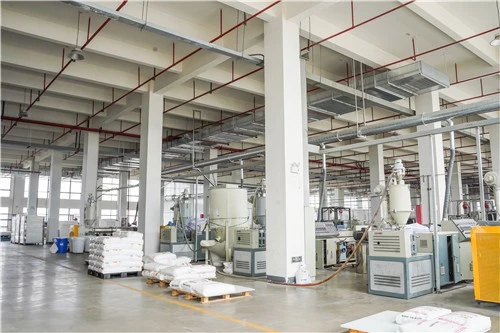
At our factory in Tongxiang, Zhejiang, we manufacture PP honeycomb panels from raw polypropylene pellets through a vertically integrated process: extrusion of the honeycomb core, face sheet production, and thermal lamination. This gives us complete control over material quality, cell size, and panel thickness.
Mechanical Properties and Performance Data
The performance of a PP honeycomb panel depends on three factors: core cell size, core density, and face sheet composition. Here are typical values from our production line, tested per ISO standards:
| Property | PP Honeycomb Panel (20mm, GF face) | Plywood (18mm) | Steel Sheet (1.5mm) |
|---|---|---|---|
| Areal Weight | 2.5-4.0 kg/m² | 9-12 kg/m² | 11.8 kg/m² |
| Flexural Strength | 15-35 MPa | 30-50 MPa | 250+ MPa |
| Flexural Modulus | 1.5-3.5 GPa | 6-8 GPa | 200 GPa |
| Water Absorption (24h) | < 0.1% | 8-15% | 0% |
| Operating Temperature | -40 to +80 C | -20 to +60 C | -40 to +400 C |
| Recyclability | 100% recyclable | Not recyclable | Recyclable |
| Corrosion Resistance | Excellent | Poor (rot, mold) | Poor (rust) |
The key insight is that while PP honeycomb panels have lower absolute strength than steel, their strength-to-weight ratio is vastly superior. A 20mm PP honeycomb panel weighing 3 kg/m2 can replace an 18mm plywood panel weighing 10 kg/m2 in most structural applications — a 70% weight reduction with comparable stiffness.
Core Cell Sizes and Their Applications
We produce PP honeycomb cores in five standard cell sizes. Each size is optimized for different performance requirements:
- 6mm cell: Highest density, maximum compressive strength. Used for heavy-load flooring in trucks and trailers. Compressive strength typically exceeds 1.5 MPa.
- 8mm cell: The most popular general-purpose size. Balances strength and weight for vehicle walls, RV floor panels, and construction partitions.
- 12mm cell: Reduced weight at moderate strength. Suitable for interior wall panels, furniture cores, and packaging applications.
- 19mm cell: Lightweight option for non-structural applications such as display boards, signage, and decorative panels.
- 25mm cell: Maximum light weight, lowest material consumption. Used for ceiling panels, acoustic barriers, and applications where weight is the primary concern.
Manufacturing Process: From Pellet to Panel
Our PP honeycomb panel production follows four main stages:
Stage 1: Core Extrusion
Raw polypropylene pellets (typically T30S grade, MFI 3-5 g/10min) are melted and extruded through a proprietary die to form individual honeycomb cells. The cells are then thermally fused into sheets. This process is covered by 8 of our 31 patents.Stage 2: Core Expansion and Calibration
The extruded core sheets are expanded to the target cell size and passed through a calibration oven to ensure uniform cell geometry. Temperature control at this stage (typically 165-175 degrees C) is critical for dimensional stability.Stage 3: Face Sheet Preparation
Face sheets are produced separately based on the application. For CFRT panels, continuous glass fiber or carbon fiber tapes are woven and consolidated with PP resin. For standard panels, glass fiber reinforced PP sheets or PET non-woven fabrics are prepared.Stage 4: Thermal Lamination
The core and face sheets are combined in a continuous press at 180-200 degrees C under controlled pressure. The thermoplastic nature of PP allows direct thermal bonding without adhesives — eliminating VOC emissions and enabling full recyclability.Total cycle time from raw material to finished panel: approximately 8-12 minutes per linear meter, depending on panel thickness and face sheet type.
Key Applications
Vehicle Bodies
PP honeycomb panels are used extensively in truck body walls, floors, and roofs. A typical 4.2m dry freight truck body using PP honeycomb panels weighs 40-60% less than a steel equivalent, directly translating to increased payload capacity and fuel savings. Our CKD (Completely Knocked Down) truck body kits use PP honeycomb panels exclusively.RV and Motorhome Construction
RV manufacturers use PP honeycomb panels for floor decking, sidewalls, and roof panels. The panels are waterproof, rot-proof, and dimensionally stable — solving the chronic moisture damage problems associated with traditional plywood-based RV construction.Construction and Architecture
In construction, PP honeycomb panels serve as lightweight partition walls, sound barriers, road isolation panels, and building facade elements. When laminated with stone veneer or HPL (High Pressure Laminate) face sheets, they provide premium aesthetics at a fraction of the weight of solid materials.Logistics and Packaging
Reusable logistics packaging, pallets, flight cases, and aviation containers benefit from the combination of light weight, impact resistance, and waterproof properties. PP honeycomb pallets can last 200+ cycles compared to 5-10 cycles for wooden pallets.PP Honeycomb Panel vs. Alternatives: Decision Matrix
| Decision Factor | PP Honeycomb | Plywood | FRP/GRP | Aluminum Composite |
|---|---|---|---|---|
| Weight | Very Low | Medium | Medium | Low |
| Cost per m2 | Medium | Low | High | High |
| Water Resistance | Excellent | Poor | Excellent | Excellent |
| Recyclability | 100% | No | No | Partial |
| Customizability | High | Low | Medium | Medium |
| Insulation Value | Moderate | Low | Low | Low |
| Best For | Vehicle bodies, construction | Interior, furniture | Marine, chemical | Facades, signage |
Frequently Asked Questions
What is the standard panel thickness range for PP honeycomb panels?
We manufacture PP honeycomb panels from 8mm to 80mm total thickness. The most common thicknesses for vehicle body applications are 20mm, 25mm, and 30mm. For construction partition walls, 40-50mm panels are typical. Custom thicknesses are available for orders above 200 square meters.
Are PP honeycomb panels fire resistant?
Standard PP is a combustible material (UL 94 HB rating). However, we offer flame-retardant formulations that achieve UL 94 V-0 or V-2 ratings, and panels can be combined with fire-rated face sheets (such as fiberglass or metal) to meet building fire codes. For specific fire performance requirements, contact our engineering team with your application details.
What is the minimum order quantity for custom PP honeycomb panels?
For standard specifications (common cell sizes, standard face sheets), our MOQ is 200 square meters. For custom colors, special cell sizes, or non-standard face materials, the MOQ is 500 square meters. Sample panels are available for evaluation — typically 300mm x 300mm test pieces.
How do PP honeycomb panels perform in extreme temperatures?
PP honeycomb panels maintain structural integrity from -40 degrees C to +80 degrees C. Below -40 degrees C, polypropylene becomes brittle. Above 80 degrees C, the material begins to soften (PP melting point is approximately 165 degrees C). For cold chain applications requiring better thermal insulation, we recommend our MPP insulation panels with micro-foamed core.
Can PP honeycomb panels be cut and drilled on site?
Yes. PP honeycomb panels can be cut with standard woodworking tools — circular saws, jigsaws, and routers all work well. Drilling is straightforward with standard HSS drill bits. Edge sealing with PP strips is recommended for exposed edges in wet environments. We provide cutting and fabrication guidelines with every order.