
Why Manufacturing Process Matters
When evaluating composite panel suppliers, most buyers focus on the finished product specifications — density, flexural strength, dimensions. But the manufacturing process determines whether those specifications are achieved consistently, batch after batch. A panel that tests well in one sample but varies wildly across a production run is worse than useless — it is a liability.
Understanding the manufacturing process also reveals which suppliers are vertically integrated (controlling quality from raw material to finished product) versus assemblers (buying cores and face sheets from third parties and bonding them together). Vertically integrated manufacturers can optimize material properties at every stage; assemblers are constrained by whatever their suppliers deliver.
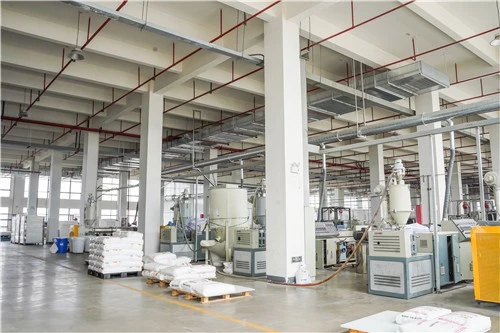
At our facility in Tongxiang, Zhejiang, we control the entire manufacturing chain: PP resin compounding, honeycomb core extrusion, face sheet production (including CFRT tape weaving), thermal lamination, CNC cutting, and final assembly. This guide walks through each stage.
Stage 1: Raw Material Preparation
Polypropylene Resin Selection
The base material for our honeycomb core is polypropylene homopolymer, typically T30S grade with a melt flow index (MFI) of 3-5 g/10min (at 230C/2.16 kg per ISO 1133). This grade provides the optimal balance of melt processability and crystallinity for honeycomb extrusion.
Key raw material specifications:
| Parameter | Specification | Test Method |
|---|---|---|
| Melt Flow Index | 3-5 g/10min | ISO 1133 |
| Tensile Strength | 33-38 MPa | ISO 527 |
| Flexural Modulus | 1.4-1.7 GPa | ISO 178 |
| Heat Deflection Temp | 100-110C (at 0.45 MPa) | ISO 75 |
| Density | 0.90-0.91 g/cm3 | ISO 1183 |
For applications requiring enhanced properties, we compound additives into the base resin:
- UV stabilizers: HALS (hindered amine light stabilizers) at 0.2-0.5% loading for outdoor panels
- Fire retardants: Magnesium hydroxide or ammonium polyphosphate at 15-30% loading for B1 fire-rated panels
- Impact modifiers: Ethylene-propylene rubber at 5-15% loading for low-temperature impact resistance
- Colorants: Masterbatch pigments for specific color requirements (standard colors: natural/translucent, white, black, gray)
Face Sheet Materials
Depending on the target panel, face sheets are prepared from different materials:
- Glass fiber reinforced PP (GF/PP): Continuous E-glass fiber rovings (17-24 um diameter, 2400-4800 tex) impregnated with PP resin in an inline impregnation die. Typical glass content: 30-60% by weight. This is our standard structural face sheet.
- CFRT (continuous fiber reinforced thermoplastic): Unidirectional glass or carbon fiber tapes (0.2-0.5mm thick, 50-300mm wide) woven into balanced or quasi-isotropic layups and consolidated at 200-220C under 2-5 MPa pressure. Our premium face sheet for maximum strength-to-weight.
- PET non-woven fabric: Polyester spunbond non-woven, 80-200 g/m2, sourced from qualified suppliers. Used for packaging and light-duty applications.
Stage 2: Honeycomb Core Extrusion
This is the heart of our manufacturing process, covered by 8 of our 31 patents.
The Extrusion Process
PP pellets are fed into a single-screw extruder (L/D ratio 30:1, barrel diameter 90-120mm) where they are melted at 200-230C and forced through a proprietary extrusion die. The die shapes the molten PP into individual half-hexagonal cells in a continuous ribbon.
Critical process parameters:
| Parameter | Typical Range | Effect of Deviation |
|---|---|---|
| Barrel Temperature | 200-230C (zones 1-4) | Low: incomplete melt, voids. High: degradation |
| Die Temperature | 215-225C | Low: poor cell formation. High: cell distortion |
| Screw Speed | 40-80 RPM | Low: low output. High: excessive shear heating |
| Line Speed | 3-8 m/min | Low: thick walls. High: thin walls, weak nodes |
| Cooling Air Temp | 20-35C | Low: premature set. High: cell distortion |
The extruded cell ribbons are then thermally fused at the node lines — alternating bond lines create the hexagonal geometry. This thermal fusion (at 175-185C, 0.2-0.5 MPa pressure) eliminates the need for adhesives, which is critical for the panel's recyclability and chemical resistance.
Core Expansion and Calibration
The fused core sheets are expanded to the target cell size by mechanical stretching at controlled temperature (165-175C). A calibration oven ensures uniform cell geometry across the full width of the sheet (up to 2400mm wide).
Quality checkpoints at this stage:
- Cell size measurement: ±0.5mm tolerance (measured with optical comparator at 10 points per sheet)
- Cell wall thickness: ±0.02mm tolerance (micrometer measurement)
- Sheet thickness uniformity: ±0.5mm across the full width
- Visual inspection: No collapsed cells, no missing node bonds, no discoloration
Stage 3: Face Sheet Production
GF/PP Face Sheets
Continuous glass fiber rovings are unwound from creels (typically 20-60 rovings) and fed through an impregnation die where molten PP is forced into the fiber bundle under 3-8 MPa pressure. The impregnated tape passes through calibration rolls to set the thickness and fiber volume fraction, then through a cooling tunnel.
The resulting GF/PP tape (0.3-0.8mm thick) is either wound onto rolls for later use or fed directly into the lamination line for inline panel production.
Quality metrics for GF/PP face sheets:
| Parameter | Specification | Test Method |
|---|---|---|
| Glass Content | 30-60% by weight | ISO 1172 (calcination) |
| Void Content | < 3% | Microscopy cross-section |
| Tensile Strength | 200-450 MPa | ISO 527 |
| Flexural Strength | 180-400 MPa | ISO 178 |
| Surface Quality | No fiber exposure, no voids | Visual inspection |
CFRT Face Sheets
For our premium CFRT panels, unidirectional tapes are woven on automated looms into multi-directional layups (typically 0/90 or 0/45/90/-45) and then consolidated in a double-belt press at 200-220C and 2-5 MPa pressure. The resulting sheet is 0.5-2.0mm thick with tensile strength exceeding 400 MPa.
CFRT production is slower and more expensive than GF/PP, which is why it is reserved for applications where maximum mechanical performance justifies the cost premium (typically 2-3x the cost of GF/PP face sheets).
Stage 4: Thermal Lamination
The core and face sheets are combined in a continuous double-belt lamination press. This is where the sandwich panel takes its final form.
Process Parameters
| Parameter | Range | Notes |
|---|---|---|
| Lamination Temperature | 180-210C | Must exceed PP melt point (165C) for thermal bond |
| Pressure | 0.1-0.5 MPa | Too high crushes core; too low gives weak bond |
| Line Speed | 1-4 m/min | Slower for thicker panels |
| Cooling Rate | Controlled, 5-15C/min | Fast cooling causes warpage |
| Panel Thickness Tolerance | ±0.3mm | Monitored by inline thickness gauge |
The key advantage of thermoplastic lamination: no adhesives. The PP core and PP-based face sheets melt and fuse at the interface, creating a monolithic bond. This bond is stronger than the parent material — in peel tests, the core cells fracture before the bond line separates. This also means no VOC emissions during manufacturing and no adhesive degradation over the panel's service life.
Inline Quality Monitoring
Our lamination line includes:
- Infrared temperature scanner: Measures surface temperature across the full panel width at 10 Hz. Alerts if any zone deviates by more than ±3C from setpoint.
- Ultrasonic bond tester: Checks core-to-face bond quality at 50mm intervals across the panel width. Detects disbonds as small as 10mm diameter.
- Thickness gauge: Laser-based, ±0.1mm accuracy. Records thickness data for every panel produced.
- Surface defect camera: Machine vision system detects surface scratches, bubbles, and contamination.
Stage 5: Cutting and Finishing
Laminated panels exit the press as continuous sheets (up to 2400mm wide) and are cut to final dimensions on a CNC panel saw or router.
Standard sheet sizes:
- 1220 x 2440mm (4 x 8 ft) — the most common worldwide standard
- 1500 x 3000mm — common in European construction
- 1250 x 2500mm — common in Asian markets
- Custom sizes up to 2400 x 12000mm (limited by transport)
- Raw cut edge: Suitable when panels will be installed into framing profiles that cover the edge
- PP edge strip (thermal welded): Seals the exposed honeycomb core. Standard for vehicle body panels
- Aluminum U-channel: Premium edge finish for furniture and architectural applications
- CNC routed profile: Custom edge profiles for specific joinery systems
Stage 6: Quality Control and Testing
Every production batch undergoes the following quality control protocol:
| Test | Method | Sampling Rate | Acceptance Criteria |
|---|---|---|---|
| Flexural Strength | ISO 178 | 1 per 200 m2 | Min 15 MPa (GF/PP face) |
| Flexural Modulus | ISO 178 | 1 per 200 m2 | Min 1.5 GPa |
| Compressive Strength | ISO 844 | 1 per 500 m2 | Per cell size spec |
| Core-Face Bond | Climbing drum peel | 1 per 500 m2 | Min 3 N/25mm |
| Thickness | Micrometer | 100% (inline) | ±0.3mm |
| Dimensions | Steel tape | 100% | ±1mm length/width |
| Water Absorption | ISO 62 (24h immersion) | 1 per batch | < 0.1% |
| Visual Inspection | Trained inspector | 100% | No defects per standard |
Panels that fail any test are quarantined and investigated. Root cause analysis follows the 8D problem-solving methodology. Quality records are retained for 5 years minimum.
Production Capacity and Lead Times
| Item | Capacity |
|---|---|
| PP honeycomb core | 3,000,000+ m2/year |
| GF/PP face sheets | 2,000,000+ m2/year |
| CFRT face sheets | 500,000+ m2/year |
| Finished sandwich panels | 2,000,000+ m2/year |
| CKD truck body kits | 5,000+ sets/year |
| Factory floor area | 50,000+ m2 |
| Production lines | 12 extrusion + 6 lamination |
| Employees | 100+ |
Lead times:
- Stock panels (standard sizes/specs): 3-5 business days
- Custom panels (non-standard specs): 15-25 business days
- CKD truck body kits: 20-30 business days
- New mold/tooling (for new cell sizes): 45-60 business days
Vertical Integration Advantage
Why does vertical integration matter for buyers?
Frequently Asked Questions
How long does it take to manufacture a custom composite panel?
From order confirmation to shipment, typical lead time is 15-25 business days for custom specifications. This includes raw material preparation (1-3 days), core extrusion (2-4 days), face sheet production (2-4 days), lamination (2-3 days), cutting and finishing (1-2 days), and quality testing (1-2 days). For repeat orders of previously manufactured specifications, lead times are reduced to 10-15 business days as tooling and process parameters are already established.
What quality certifications does your factory hold?
Our manufacturing facility is certified to ISO 9001:2015 (Quality Management), and HOTECH is a recognized National High-Tech Enterprise. Our material testing is validated by SGS. We hold 31 patents covering honeycomb core extrusion, CFRT production, and panel lamination technology. For specific product applications, we provide test reports per relevant standards (ISO 178, ISO 844, DIN 4102, FMVSS 302).
Can you manufacture panels to our proprietary specifications?
Yes. We regularly manufacture panels to customer specifications, including custom cell sizes, non-standard thicknesses, specific fiber volume fractions, and proprietary face sheet combinations. Our engineering team works with customers from the specification stage through prototype validation and production ramp-up. Minimum order for custom specifications is 200 m2. We sign NDAs for proprietary applications as a matter of course.
What is the difference between your panels and those from assemblers?
Vertically integrated manufacturers like HOTECH extrude the honeycomb core, produce the face sheets, and laminate the finished panel in-house. Assemblers purchase cores and face sheets from third parties and bond them together, often using adhesive rather than thermal fusion. The key differences: (1) thermal fusion creates a stronger, more durable bond than adhesive; (2) no adhesive means no VOC emissions and full recyclability; (3) we can optimize each material layer for the specific application; (4) single-source accountability for quality issues.
How do you ensure consistent quality across large production runs?
Our quality system has three layers: (1) incoming material inspection (every resin batch, every fiber lot); (2) in-process monitoring (infrared temperature scanning, ultrasonic bond testing, inline thickness measurement — all automated and continuous); (3) final product testing (flexural strength, compressive strength, bond strength, water absorption — sampled per our QC protocol). All data is recorded in our MES (Manufacturing Execution System) and linked to individual panel serial numbers for full traceability.
Tour Our Factory
We welcome customers and partners to visit our production facility in Tongxiang, Zhejiang. See the manufacturing process firsthand, meet our engineering team, and discuss your application requirements in person. We are located 90 minutes from Shanghai Pudong International Airport (PVG) and 60 minutes from Hangzhou Xiaoshan International Airport (HGH).
![PP Honeycomb Panel — Properties, Applications & How It's Made [2026]](/images/products/pp-honeycomb-panel.jpg)