What Makes PP Honeycomb Panels Different
A polypropylene (PP) honeycomb panel is a sandwich composite: two rigid face sheets bonded to a thermoplastic honeycomb core. The hexagonal cell geometry — borrowed from nature — distributes loads across thousands of micro-columns, delivering structural rigidity at a fraction of the weight of solid materials.
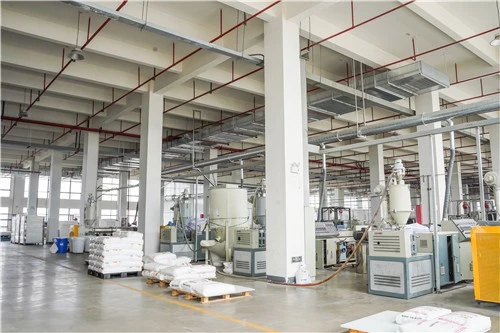
Unlike traditional building materials, PP honeycomb panels are manufactured entirely from thermoplastic polypropylene. This means zero water absorption, complete corrosion immunity, and 100% end-of-life recyclability. At our facility in Tongxiang, Zhejiang, we extrude both the honeycomb core and the face sheets in-house, giving us full control over cell size, density, and panel thickness from 5mm to 80mm.

The result is a panel that weighs 60-75% less than the plywood or steel sheet it replaces — while matching or exceeding performance on every metric that matters in real-world applications.
Mechanical Properties: The Numbers That Matter
Every purchasing decision starts with data. Here are the tested mechanical properties of our standard PP honeycomb panels compared against the materials they most commonly replace, tested per ISO 178 (flexural) and ISO 844 (compression):
| Property | PP Honeycomb 20mm (GF face) | Plywood 18mm (Birch) | Steel Sheet 1.5mm | Aluminum Sheet 2mm | FRP Panel 3mm |
|---|---|---|---|---|---|
| Areal Density | 2.5-4.0 kg/m2 | 9.0-12.0 kg/m2 | 11.8 kg/m2 | 5.4 kg/m2 | 4.5-6.0 kg/m2 |
| Flexural Strength | 15-35 MPa | 30-50 MPa | 250+ MPa | 150-280 MPa | 120-200 MPa |
| Flexural Modulus | 1.5-3.5 GPa | 6.0-8.0 GPa | 200 GPa | 70 GPa | 8-12 GPa |
| Compressive Strength | 0.8-2.5 MPa | 5-10 MPa | N/A (sheet) | N/A (sheet) | N/A (sheet) |
| Water Absorption (24h) | < 0.1% | 8-15% | 0% | 0% | 0.5-2.0% |
| Operating Temp Range | -40 to +80C | -20 to +60C | -40 to +400C | -40 to +200C | -30 to +120C |
| Thermal Conductivity | 0.06-0.08 W/mK | 0.12-0.17 W/mK | 50 W/mK | 205 W/mK | 0.2-0.4 W/mK |
| Recyclability | 100% | No | Yes (downcycle) | Yes | No (thermoset) |
| UV Resistance | Good (with stabilizer) | Poor | Excellent | Excellent | Good |
| Cost per m2 (20mm equiv) | $8-18 | $6-14 | $15-35 | $25-50 | $20-40 |
Core Density and Cell Size Selection
The mechanical performance of a PP honeycomb panel is primarily determined by three variables: cell size, core thickness, and face sheet composition. We manufacture five standard cell sizes, each optimized for different load requirements:
| Cell Size | Core Density (kg/m3) | Compressive Strength (MPa) | Best Applications |
|---|---|---|---|
| 6mm | 80-120 | 1.5-2.5 | Heavy-load truck floors, forklift-rated pallets |
| 8mm | 60-90 | 1.0-1.8 | Vehicle walls, RV floor panels, construction partitions |
| 12mm | 40-65 | 0.6-1.2 | Interior walls, furniture cores, display boards |
| 19mm | 25-45 | 0.3-0.7 | Signage, decorative panels, acoustic barriers |
| 25mm | 18-35 | 0.2-0.5 | Ceiling panels, lightweight packaging, non-structural |
Custom cell sizes between 5mm and 30mm are available for OEM orders above 500 m2.
Face sheet options further expand the performance envelope:- Glass fiber reinforced PP (GF/PP): Standard for structural applications. Adds 15-25 MPa flexural strength. Weight: 0.8-1.5 kg/m2 per face.
- PET non-woven fabric: Low-cost option for packaging and interior applications. Weight: 0.1-0.3 kg/m2 per face.
- CFRT (continuous fiber reinforced thermoplastic): Premium option for maximum strength-to-weight. Adds 30-60 MPa flexural strength. Used in truck floors and aerospace applications.
- HPL (high-pressure laminate): Decorative finish for furniture, partitions, and architectural applications.
- Metal foil (aluminum/steel): For electromagnetic shielding or enhanced surface hardness.
7 Industries Where PP Honeycomb Replaces Plywood
1. Commercial Vehicle Bodies
The largest application by volume. A 4.2-meter dry freight truck body built with PP honeycomb panels weighs 350-450 kg compared to 700-900 kg for the equivalent steel/plywood body. That 40-60% weight reduction translates directly to increased payload capacity — our clients typically gain 300-500 kg of additional cargo weight per trip.
Annual fuel savings per vehicle: $1,200-2,400 (based on 80,000 km/year at $1.50/L diesel, 3-5% fuel reduction per 100 kg weight savings). Over a 10-year vehicle lifecycle, the fuel savings alone exceed the material cost premium 3-5x.
2. RV and Motorhome Construction
RV manufacturers face a chronic problem: wood-core panels absorb moisture, leading to delamination, mold, and structural rot. PP honeycomb panels with < 0.1% water absorption eliminate this failure mode permanently. The weight savings (typically 80-150 kg for a Class C motorhome) improve fuel economy and increase payload within GVWR limits.
3. Cold Chain Logistics
Refrigerated truck bodies require panels with low thermal conductivity and zero moisture absorption — both areas where PP honeycomb dramatically outperforms plywood. Our MPP (micro-foamed PP) insulation panels achieve thermal conductivity of 0.035-0.045 W/mK, comparable to PU foam but without the CFC/HCFC concerns.
4. Reusable Packaging and Pallets
PP honeycomb pallets last 200+ reuse cycles versus 5-10 for wooden pallets. They weigh 60% less, are impervious to moisture and insects, and pass through fumigation-free customs clearance (no ISPM-15 treatment required). For companies shipping 10,000+ pallets annually, the lifecycle cost reduction is 40-65%.
5. Construction and Architecture
Lightweight partition walls, sound barriers, road isolation panels, and building facade elements. When laminated with stone veneer or HPL, PP honeycomb panels provide the aesthetics of solid stone or wood at 15-20% of the weight. A 20mm honeycomb panel with 2mm stone veneer weighs approximately 7 kg/m2 versus 50+ kg/m2 for 20mm solid stone.
6. Furniture and Interior Design
Tabletops, cabinet doors, shelving panels, and office partitions. The flat, dimensionally stable surface accepts laminate, veneer, and paint finishes. Unlike MDF or particleboard, PP honeycomb will not swell or warp when exposed to humidity.
7. Automotive Components
Spare tire covers, package trays, interior panels, and trunk floor panels. Automotive OEMs are increasingly specifying PP honeycomb to meet lightweighting targets (EU CO2 regulations require fleet-average emissions below 95 g/km by 2030). A typical sedan can save 8-15 kg by switching interior panels from glass-fiber-reinforced urethane to PP honeycomb composites.
Total Cost of Ownership: PP Honeycomb vs. Plywood
The upfront cost of PP honeycomb panels is typically 20-40% higher than plywood. However, the total cost of ownership (TCO) over a 5-10 year service life tells a very different story:
| Cost Factor | PP Honeycomb Panel | Plywood Panel |
|---|---|---|
| Material cost (20mm, per m2) | $12-18 | $8-14 |
| Installation labor | Same | Same |
| Waterproofing treatment | Not required | $2-4/m2 every 2 years |
| Replacement frequency (trucks) | 8-12 years | 3-5 years |
| Fuel savings (vehicles, annual) | $1,200-2,400 | Baseline |
| Disposal cost | Recyclable (revenue) | Landfill ($3-8/m2) |
| Fumigation (export) | Not required | $0.50-1.50/m2 per shipment |
| 10-year TCO per m2 | $14-22 | $32-58 |
Design Guidelines for Engineers
When specifying PP honeycomb panels for a new application, follow these guidelines:
Frequently Asked Questions
How strong is a PP honeycomb panel compared to plywood?
A 20mm PP honeycomb panel with glass fiber face sheets delivers 15-35 MPa flexural strength versus 30-50 MPa for 18mm birch plywood. However, the honeycomb panel weighs only 2.5-4.0 kg/m2 compared to 9-12 kg/m2 for plywood. In strength-to-weight terms, the PP panel is approximately twice as efficient. For most applications — vehicle bodies, partitions, furniture cores — the PP panel matches plywood performance at 60-75% less weight.
What is the maximum temperature for PP honeycomb panels?
The standard operating range is -40C to +80C. At temperatures above 80C, the polypropylene begins to soften and mechanical properties degrade significantly. For applications requiring higher temperature resistance (up to 120C), we recommend our CFRT panels with a modified PP matrix, or specify aluminum honeycomb core panels. For cold environments down to -40C, PP honeycomb performs well — the material becomes slightly stiffer but maintains structural integrity.
Are PP honeycomb panels fire-rated?
Standard PP honeycomb panels achieve UL94 HB (horizontal burn) classification — they are self-extinguishing but not inherently fire-rated. For applications requiring fire ratings (B1 DIN 4102, Class A ASTM E84), we add fire-retardant additives to both the core and face sheets. Our FR-grade panels achieve B1 classification with a flame spread index below 25. We can provide specific fire test reports for your application requirements.
Can PP honeycomb panels be CNC machined and fabricated?
Yes. PP honeycomb panels can be cut with standard woodworking tools — circular saws (carbide-tipped blades), CNC routers, and even hand tools. They can be drilled, routed, and edge-profiled. For joining, options include mechanical fasteners (self-tapping screws work well), structural adhesives (polyurethane or methacrylate), and thermal welding of PP edge strips. The panels cannot be bent to tight radii but can be thermoformed to gentle curves (radius > 500mm) at 160-180C.
What is the minimum order quantity for custom PP honeycomb panels?
Our standard MOQ is 200 m2 for custom specifications (specific cell size, thickness, and face sheet combination). For standard products (8mm cell, 20mm thickness, GF/PP face sheets), we maintain stock in common sheet sizes (1220x2440mm and 1500x3000mm) with no MOQ restriction. Lead time is 15-25 days for custom orders, 3-5 days for stock items.
Source PP Honeycomb Panels
HOTECH manufactures PP honeycomb panels at our 50,000+ sqm facility in Tongxiang, Zhejiang, with 31 patents covering core extrusion and panel lamination technology. We supply panels, CKD vehicle body kits, and complete engineering support from material selection through production.