The Core Debate: Honeycomb vs Foam in 2026
The pickleball paddle industry is in the middle of a core material debate. For over a decade, polypropylene (PP) honeycomb has been the default core technology — used in an estimated 90%+ of paddles worldwide. In 2026, foam core paddles emerged as the alternative, with brands like Bread & Butter, Ronbus, and others championing full-foam or foam-enhanced constructions.
As a manufacturer that produces both PP honeycomb core and MPP (micro-foamed polypropylene) panels, HOTECH is in a unique position to compare these technologies objectively. We don't have a stake in which technology "wins" — we supply both to paddle brands. This guide shares what we've learned from the production floor.
How Each Technology Works
PP Honeycomb Core
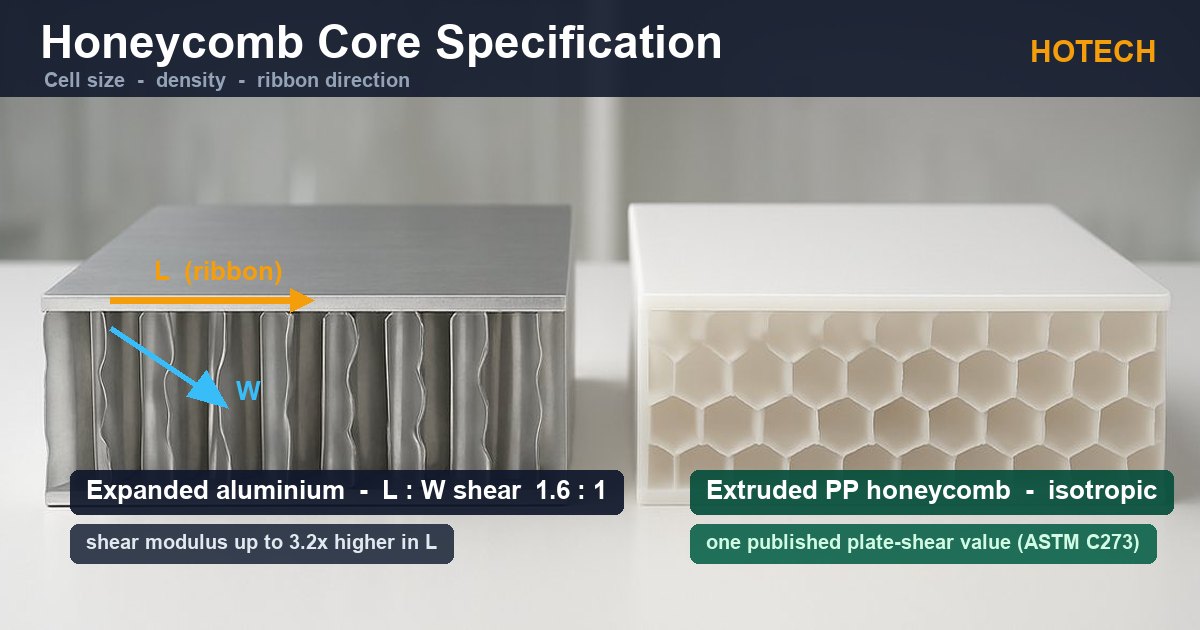
PP honeycomb is a lightweight structural material made from extruded polypropylene formed into a hexagonal cell pattern. The hexagonal geometry distributes loads efficiently across the entire structure — it's the same principle that makes beehives strong enough to support their own weight plus stored honey.
In a paddle, the honeycomb core sits between two face sheets (carbon fiber, fiberglass, or hybrid). When the ball strikes the paddle, the honeycomb cells compress slightly and spring back, returning energy to the ball. The cell size (typically 6–19 mm) and cell wall thickness determine how stiff or compliant the core feels.
Production process: Continuous extrusion → sheet forming → thermal bonding → thickness calibration → quality inspection. This is a mature, high-volume process with excellent repeatability.Foam Core
Foam cores use a solid polymer material — typically injected polyurethane (PU), expanded polypropylene (EPP), or proprietary blends — that fills the entire core cavity uniformly. Unlike honeycomb, there are no individual cells or cell walls. The foam structure absorbs and returns energy through the compression of millions of tiny closed-cell bubbles distributed throughout the material.
Production process: Chemical mixing → mold injection or sheet foaming → curing → trimming → quality inspection. More process variables than honeycomb extrusion.Head-to-Head Comparison
| Property | PP Honeycomb Core | Foam Core | Notes |
|---|---|---|---|
| Weight (at equivalent stiffness) | Lighter (60–100 kg/m³) | Heavier (90–150 kg/m³) | Honeycomb achieves same rigidity at lower density |
| Sweet Spot Uniformity | Cell-pattern variation | More uniform edge-to-edge | Foam's main advantage |
| Energy Return | High, predictable | Moderate, dampened | Honeycomb returns more energy (power) |
| Vibration Dampening | Moderate | High | Foam better for arm-friendly paddles |
| Noise Level | Moderate to loud | Quiet | Foam significantly quieter |
| Long-Term Durability | Cells may compress over time | Foam may soften over time | Both degrade, differently |
| Moisture Resistance | Waterproof (< 0.1% absorption) | Varies by foam type | PU foam can absorb moisture |
| Manufacturing Cost | Lower (30–50% less) | Higher | At equivalent paddle specs |
| Recyclability | 100% recyclable (thermoplastic PP) | Usually not (thermoset PU) | EPP foam is recyclable |
| Production Consistency | Very high (mature process) | More variables | Temperature, mix ratios, cure time |
| Weight Customization | Via cell size and wall thickness | Via foam density | Both offer flexibility |
| Face Sheet Bonding | Thermal lamination (strong) | Adhesive bonding (adequate) | Honeycomb bonds more reliably |
What Paddle Manufacturers Should Consider
If You're Launching a Budget-to-Mid-Range Line ($30–$80 Retail)
PP honeycomb is the clear choice. The cost advantage is too significant to ignore when margins are tight. An 8 mm PP honeycomb core with fiberglass face sheets delivers a reliable, consistent paddle at a core material cost that foam simply cannot match. At this price point, the incremental performance benefits of foam do not justify the higher BOM cost.
If You're Launching a Premium Line ($100+ Retail)
Both technologies are viable. Foam core enables "premium positioning" marketing and genuinely delivers a different feel profile. However, a well-engineered 6 mm PP honeycomb core with carbon fiber CFRT faces can match or exceed foam paddle performance at a lower material cost — increasing your margin or allowing investment in other premium features (better edge guard, custom graphics, premium handle wrap).
If Noise Reduction Is a Priority
Foam cores are genuinely quieter. For paddles marketed for indoor play, community courts with noise restrictions, or the growing "quiet paddle" segment, foam has a real advantage. However, PP honeycomb paddles can also be made quieter by using larger cell sizes (16–19 mm) and adding a thin foam dampening layer between the core and face sheets — a hybrid approach that keeps honeycomb's cost and weight benefits.
If Sustainability Matters to Your Brand
PP honeycomb is the clear winner. It is a single-material thermoplastic that can be melted and re-extruded at end of life. Most foam cores use thermoset polyurethane that cannot be recycled. As sustainability becomes a purchasing factor for consumers, this distinction will grow in importance.
Testing Both Options: What We Recommend
Before committing your entire product line to either technology, we suggest a structured evaluation: