Why PP Honeycomb Dominates Pickleball Paddle Cores
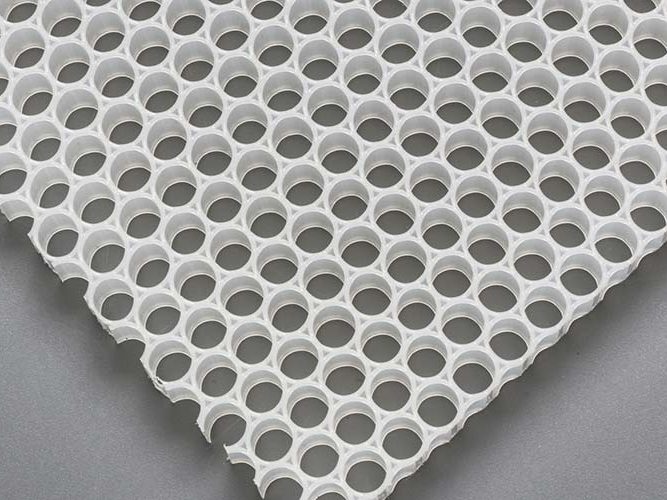
Polypropylene honeycomb is the most widely used core material in pickleball paddles today. Industry estimates suggest that over 90% of paddles on the market use some form of polymer honeycomb core — and the vast majority of those are PP (polypropylene). The reasons are straightforward: PP honeycomb offers an excellent balance of lightweight construction, energy absorption, cost efficiency, and manufacturing consistency that no other core material can match at scale.
As a PP honeycomb core manufacturer with a patented paddle core design, HOTECH supplies core sheets and finished sandwich panels to paddle brands across North America, Europe, and Asia-Pacific. This guide covers what paddle manufacturers need to know when sourcing honeycomb cores for production.
How Cell Size Affects Paddle Performance
The single most important specification for a pickleball paddle core is cell size — the diameter of each hexagonal cell in the honeycomb structure. Cell size directly controls the playing characteristics of the finished paddle.
Small Cells (6–8 mm): Power & Control
Smaller cells pack more cell walls per unit area, creating a denser, stiffer core. This translates to:
- Higher energy return on impact — the ball rebounds faster off the paddle face
- More predictable ball response — less deflection variation across the paddle surface
- Greater overall rigidity — the paddle feels "solid" and responsive
- Slightly higher weight per unit area compared to larger cells
Large Cells (12–19 mm): Soft Touch & Dampening
Larger cells create a more compliant, energy-absorbing core:
- Softer feel on impact — the ball "dwells" slightly longer on the paddle face
- Better vibration dampening — less stress on the player's arm and elbow
- Reduced noise — larger cells produce a quieter impact sound
- Lower weight per unit area for ultra-lightweight paddle designs
Cell Size Selection Matrix for Paddle Manufacturers
| Cell Size | Core Density | Playing Feel | Best For | Noise Level |
|---|---|---|---|---|
| 6 mm | 100–120 kg/m³ | Stiff, powerful | Tournament / power players | Moderate |
| 8 mm | 80–100 kg/m³ | Balanced | All-around (most popular) | Moderate |
| 12 mm | 60–80 kg/m³ | Soft, dampened | Recreational / touch players | Low |
| 16 mm | 50–65 kg/m³ | Very soft | Ultra-light / arm-friendly | Very low |
| 19 mm | 40–55 kg/m³ | Cushioned | Specialty / noise-reduction | Lowest |
Core Thickness Options
Standard pickleball paddle cores range from 10 mm to 16 mm thick. Core thickness affects the overall paddle thickness and playing characteristics:
- 10–11 mm (thin): Thinner paddles with smaller sweet spots but more "pop" and faster hand speed due to lower air resistance. Preferred by advanced players who want maximum maneuverability.
- 13 mm (standard): The most common core thickness. Balanced performance across power, control, and sweet spot size.
- 14–16 mm (thick): Larger sweet spot and softer feel. More forgiving on off-center hits. Popular for recreational and intermediate players.
Face Sheet Pairing: What Goes on Top of the Core
The core is only half the equation. The face sheets bonded to each side of the honeycomb core have an equally significant impact on paddle performance.
Carbon Fiber CFRT Face Sheets
Carbon fiber reinforced thermoplastic face sheets are the premium option. They deliver maximum stiffness and energy return with minimal weight. Carbon faces produce a "crisp" feel and generate more power. HOTECH supplies CFRT face sheets in 0.3–2.0 mm thickness with options for raw (textured) or smooth finishes.
Carbon fiber faces are the standard for competition-grade paddles priced above $80 retail.
Fiberglass Face Sheets
Glass fiber reinforced PP face sheets offer a softer, more flexible playing surface compared to carbon. The ball stays on the face slightly longer, giving players more control and "touch." Fiberglass is also more affordable than carbon fiber.
Fiberglass faces are common in mid-range paddles ($40–$80 retail) and in paddles designed for recreational play.
Hybrid Configurations
Some paddle brands use different face materials on each side — for example, carbon fiber on the hitting face for power and fiberglass on the back for weight balance. We can produce asymmetric sandwich panels for these designs.
The 2026 Foam Core Trend: What It Means for Honeycomb
In 2026, several paddle brands introduced foam core paddles as an alternative to traditional honeycomb construction. Foam cores use injected polyurethane or proprietary polymer foams that fill the entire core cavity instead of using a honeycomb structure.
What Foam Core Claims to Solve
Foam core proponents cite three advantages: a more uniform feel across the entire paddle face (no cell-to-cell variation), better long-term consistency (honeycomb cells can compress with heavy use), and a slightly larger effective sweet spot.
The Manufacturer's Perspective on Foam vs Honeycomb
As a company that produces both PP honeycomb core and MPP micro-foamed polypropylene panels, we see the foam-vs-honeycomb debate from the production side:
Honeycomb advantages that foam cannot match:- Weight efficiency: A honeycomb core at 60–80 kg/m³ density achieves the same stiffness-to-weight ratio as foam at 100+ kg/m³. Honeycomb paddles are inherently lighter at equivalent performance.
- Breathability and moisture management: The open-cell structure of honeycomb allows air circulation. Foam is closed-cell and can trap moisture if the face sheet seal is compromised.
- Production consistency at scale: Honeycomb sheet production is a continuous, highly repeatable process. Foam injection involves chemical reactions with more variables (temperature sensitivity, cure time, density uniformity).
- Recyclability: PP honeycomb is 100% recyclable as a single-material thermoplastic. Most foam cores are thermoset (PU) and cannot be recycled.
- Cost: At equivalent paddle performance levels, honeycomb cores cost 30–50% less than foam alternatives.
- Edge-to-edge feel uniformity — no hexagonal cell pattern visible through thin face sheets
- Noise reduction — foam cores are generally quieter than honeycomb
- Marketing differentiation — "foam core" is currently a premium positioning tool
Our Take
The vast majority of the market will continue using PP honeycomb cores because the cost, weight, and manufacturing advantages are too significant to abandon. Foam cores will occupy a premium niche for players willing to pay more for a different feel profile. Both technologies will coexist, just as they do in surfboards and other sports equipment.
For paddle manufacturers evaluating the switch, we recommend requesting sample panels of both constructions and conducting blind playtesting before committing to a production change.
OEM Sourcing: How to Order Paddle Cores from HOTECH
What We Supply
- Raw honeycomb core sheets: PP honeycomb in your specified cell size, density, and thickness. Cut to standard sheet size (up to 3000 × 1350 mm) or custom dimensions.
- Pre-laminated sandwich panels: Honeycomb core already bonded to CFRT or fiberglass face sheets on both sides. Ready for CNC cutting into paddle shapes.
- CNC-cut paddle blanks: Finished paddle-shaped panels with your specified outline, edge radius, and handle slot. Ready for edge banding and finishing.
Minimum Order Quantities
For sampling and initial testing, we have no minimum — we ship sample panels for evaluation. For production orders, our MOQ depends on the level of customization. Standard cell sizes and thicknesses can ship in quantities as small as 50 sheets. Custom cell configurations or specialized face sheet laminations may require higher minimums, which we discuss on a per-project basis.
Quality Control
Every batch of honeycomb core is tested for cell size uniformity, density consistency, and flatwise compression strength per ASTM C365. Sandwich panel lots are additionally tested for peel strength (ASTM D1781) and flexural rigidity. Test reports are provided with each shipment.
Lead Time and Shipping
Standard core sheets ship within 7–10 business days from order confirmation. Custom laminated panels require 15–20 business days. We ship worldwide via sea freight (cost-effective for bulk orders) or air freight (for samples and urgent orders).