The Specification Most RFQs Send Us Is Incomplete
We quote honeycomb core and composite sandwich panels every working day. The typical enquiry arrives with three numbers: thickness, cell size, and sometimes density. Those three are genuinely necessary, and they are also the three that determine the least about whether the finished panel will work.
Hexcel's own specification guidance lists what a core callout actually needs:
- Material (aluminum alloy, aramid, fiberglass, carbon, polypropylene)
- Cell configuration (hexagonal, OX-Core, Flex-Core, underexpanded)
- Cell size
- Alloy and foil gauge (aluminum honeycomb only)
- Density
Cell sizes across the industry run from 1/16 inch to 1 inch, with 1/8, 3/16, 1/4 and 3/8 inch being the common four. Densities run from 1.0 lb/ft3 up to 55 lb/ft3 — a 55-fold range in one material family. "Aluminum honeycomb, 25 mm thick" narrows almost nothing.
But the field that causes the most real-world surprises is not in that list at all, because it is not a property of the core you order. It is a property of how you lay it into the panel.
Ribbon Direction: Where L and W Come From
Expanded honeycomb — the process used for nearly all aerospace-grade aluminum and aramid core — is not cut from a solid. Adhesive node lines are printed onto stacked sheets of foil or paper, cured into a block Hexcel calls a HOBE (HOneycomb Before Expansion), and then pulled apart. The sheets separate everywhere except at the printed node lines, and the hexagons open up.
That process leaves a permanent asymmetry in the geometry. The cell walls that sit along the node lines are two sheets thick, bonded together. The inclined walls that opened up during expansion are one sheet thick. So the finished core has:
- L direction — the ribbon direction, parallel to the original foil ribbons, where the doubled node walls run
- W direction — transverse to the ribbon, where only single-thickness inclined walls resist shear
- T direction — through thickness, the direction of flatwise compression
The corrugated process — used mainly for high density core — stacks pre-corrugated sheets rather than expanding a block, but the result is the same: a defined ribbon direction with doubled node walls.
This is why every serious aluminum and aramid honeycomb datasheet has two plate shear columns, not one.
What the Anisotropy Actually Costs You
Here is Hexcel's published data for 5052 alloy hexagonal aluminum honeycomb, specification grade, all tested per plate shear at 0.625 inch core thickness. I have added the ratio columns, which the datasheet does not print.
| Designation (cell – alloy – foil) | Density (pcf) | L shear strength (psi) | L shear modulus (ksi) | W shear strength (psi) | W shear modulus (ksi) | L/W strength | L/W modulus |
|---|---|---|---|---|---|---|---|
| 1/8 – 5052 – .0007 | 3.1 | 210 | 45.0 | 130 | 22.0 | 1.62x | 2.05x |
| 1/8 – 5052 – .001 | 4.5 | 340 | 70.0 | 220 | 31.0 | 1.55x | 2.26x |
| 1/8 – 5052 – .002 | 8.1 | 800 | 135.0 | 470 | 54.0 | 1.70x | 2.50x |
| 3/16 – 5052 – .0015 | 4.4 | 330 | 68.0 | 215 | 30.0 | 1.53x | 2.27x |
| 1/4 – 5052 – .002 | 4.3 | 320 | 66.0 | 200 | 29.8 | 1.60x | 2.21x |
| 3/8 – 5052 – .003 | 4.2 | 310 | 65.0 | 200 | 29.0 | 1.55x | 2.24x |
| 1/16 – 5052 – .0015 | 12.4 | 1150 | 210.0 | 715 | 65.0 | 1.61x | 3.23x |
Two things fall out of this table that matter more than any single number in it.
First, the ratio is remarkably stable. Across cell sizes from 1/16 to 3/8 inch and densities from 3.1 to 12.4 pcf, L/W shear strength sits between 1.53x and 1.70x. You can treat "about 1.6x" as a working rule for hexagonal aluminum core. Second, the modulus penalty is much worse than the strength penalty. L/W modulus ranges from 2.05x to 3.23x — consistently higher than the strength ratio. This is the part that catches people out. If you orient a core 90 degrees from intended, you usually do not fail the panel; you fail the deflection spec. The panel holds the load and sags. Stiffness-driven designs — a trailer floor, an RV sidewall that has to stay flat, a display panel with a flatness callout — degrade far more than the strength numbers suggest.There is a third, quieter point. Look at the 1/8 – 5052 – .0007 row (3.1 pcf) and the 1/4 – 5052 – .002 row (4.3 pcf). The heavier core has higher L shear — but if the 4.3 pcf core is installed in W and the 3.1 pcf core in L, the lighter core out-shears the heavier one (210 psi vs 200 psi) while weighing 28% less. Paying for density to fix a problem caused by orientation is the most expensive mistake in this whole article.
Overexpanded Core Deliberately Inverts the Ratio
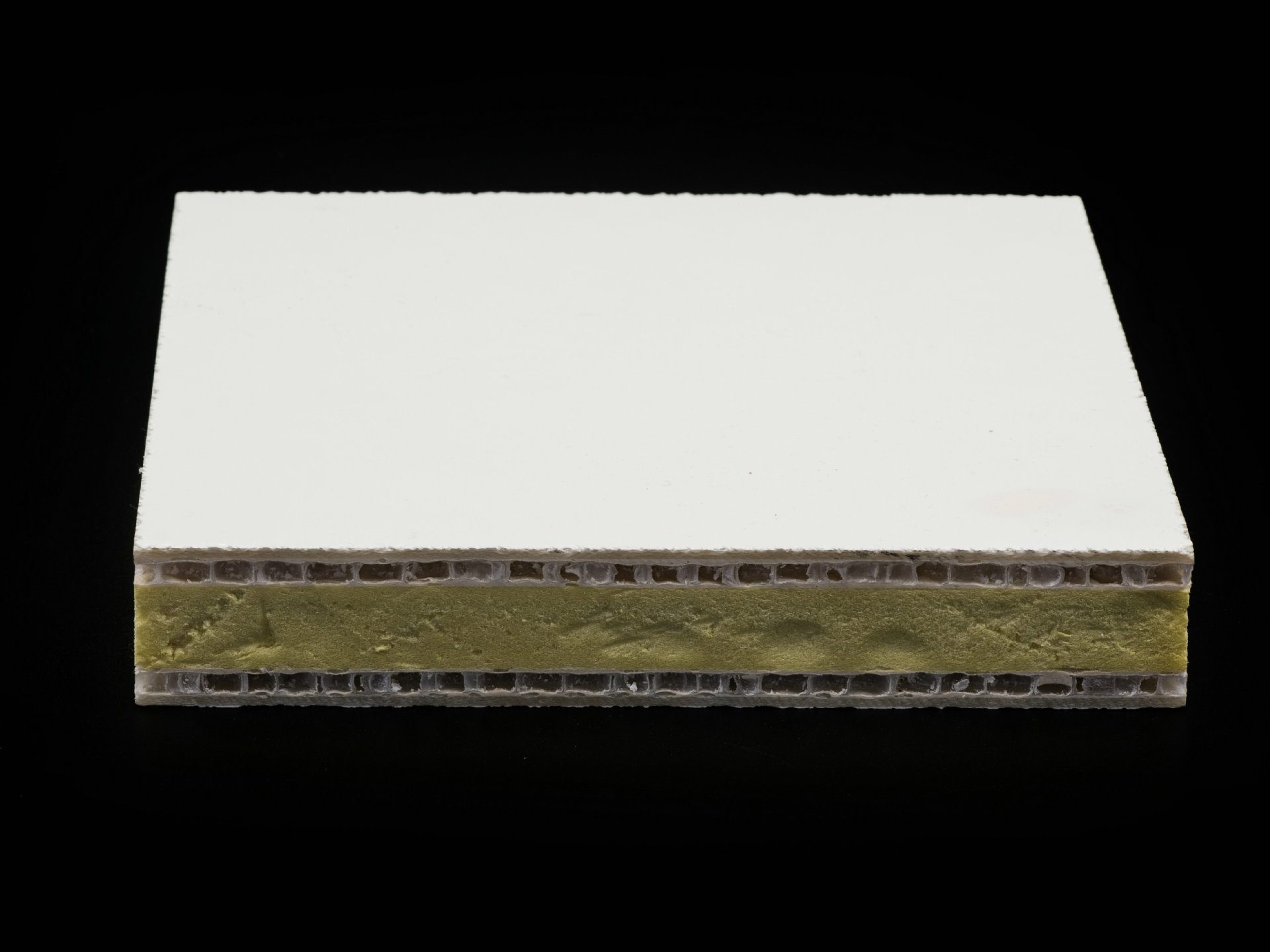
If the anisotropy were purely a nuisance, nobody would sell more of it. OX-Core is hexagonal honeycomb that has been overexpanded in the W direction, producing near-rectangular cells. Hexcel is explicit about the trade: the OX process increases W shear properties and decreases L shear properties compared with standard hexagonal core.
Why buy that? Because overexpanding makes the core drape. A rectangular cell will curve around a radius in the L direction without crushing, which is exactly what you need for a curved roof cap, a radiused corner, or a formed leading edge. You are spending L shear to buy formability, and you get some W shear back as change.
This is the cleanest proof that L and W are not a labelling convention. They are a real, tunable, manufacturable property — and a supplier who cannot tell you which one your core is optimised for has not understood your part.
Extruded PP Honeycomb: When the Core Has No Ribbon Direction
Now the part that is genuinely different, and that most engineering references — written for aerospace metal and aramid core — do not cover.
Thermoplastic polypropylene honeycomb is not made by the expansion process. There are two dominant routes:
The tube route has no foil ribbons and therefore no doubled node walls. Plascore describes the result directly: a multi-axial structure providing isotropic performance, with "near equal shear properties in all directions." And their datasheet reflects that — it publishes one plate shear strength column and one modulus column, with no L or W split:
| Core | Cell size | Density | Bare compression, typical (ASTM C365) | Plate shear strength, typical (ASTM C273) | Plate shear modulus, typical |
|---|---|---|---|---|---|
| PP1-5.0-N1-8 | 8 mm (0.315 in) | 80 kg/m3 (5.0 pcf) | 1.89 MPa (275 psi) | 0.58 MPa (85 psi) | 15.2 MPa (2.2 ksi) |
| PP1-4.0-N1-10 | 10 mm (0.395 in) | 64 kg/m3 (4.0 pcf) | 1.24 MPa (180 psi) | 0.41 MPa (60 psi) | 13.8 MPa (2.0 ksi) |
The practical consequences of that single column are worth spelling out, because they are the reason PP honeycomb is the default core in vehicle body work rather than aerospace-style aluminum:
- Nesting is free. With an isotropic core you can rotate parts on the sheet purely to maximise yield. On an anisotropic core, rotating a part 90 degrees to save material can quietly halve its stiffness. On large panel runs this is a real cost difference, not a rounding error.
- There is no orientation to specify, verify, or get wrong in the shop. No arrow to print on the sheet, no incoming-inspection step, no rework when an operator lays a blank the wrong way.
- Two-way bending performance is symmetric. For a truck body sidewall or an RV floor loaded unpredictably in service, symmetric properties are worth more than a high number in one axis.
At our own plant in Tongxiang we extrude PP honeycomb core from raw polypropylene pellets in cell sizes of 6, 8, 12, 19 and 25 mm, with flatwise compressive strength from 0.5 to 3.0 MPa per ASTM C365 (our standard 8 mm cell runs 1.5 to 2.0 MPa) and water absorption below 0.1% per ASTM D570. The full range is on the PP honeycomb core page.
The Numbers on the Datasheet Are Not the Numbers in Your Panel
Three adjustments separate a published core value from the value your part will see. All three are in the source documents and all three are routinely skipped.
1. Thickness correction. Honeycomb shear strength varies with core thickness — and not in the direction most people guess. A plate shear test induces a minor tensile component parallel to the cell axis, so the core is loaded in combined shear and tension rather than pure shear. Thicker cores have lower usable shear strength than thinner ones. Published aluminum data is measured at 0.625 inch core thickness; non-metallic honeycomb is measured at 0.500 inch. If you are running 25 mm (about 1 inch) core, you are outside the test condition and need the supplier's correction factor. 2. Test method mismatch. Plate shear per ASTM C273 and beam flexure per ASTM C393 do not give the same answer. Core shear values obtained from flexure tests are often higher than plate shear values, because beam flexure measures the facings, adhesive and core acting as a composite and the skins carry some of the shear load. Do not benchmark one supplier's C273 data against another's C393 data and conclude the second core is stronger. 3. Density tolerance. Hexcel certifies aerospace-grade core to within ±10% of nominal density. Commercial-grade aluminum core is ±17%. Industry practice for cell size is also nominal ±10%. If your structural margin is under 20%, a compliant delivery at the bottom of the tolerance band can still put you under your design allowable — and nobody has done anything wrong.| Property | Standard | Standard specimen / condition |
|---|---|---|
| Flatwise (bare and stabilized) compression | ASTM C365, MIL-STD-401 | 3 in L x 3 in W x 0.625 in T (aluminum); 0.500 in T (non-metallic); 0.020 in/min |
| Plate shear, L and W | ASTM C273 | 6 in x 2 in x 0.500 in T non-metallic, bonded to 0.5 in steel plates; 0.020 in/min |
| Core shear via sandwich beam | ASTM C393, MIL-C-7438 | 8 in x 3 in specimen, 6 in span, one or two point load |
| Core thickness | ASTM C366 Method B | Measured to 0.001 in |
| Water absorption (thermoplastic core) | ASTM D570 | 24 h immersion |
One more testing footnote worth knowing before you argue with a supplier's data: honeycomb at 8.0 pcf and above is sometimes difficult to fail in plate shear at all, because the load needed exceeds the strength of the adhesive bond to the steel test plates. For heavy, thick cores the beam-flexure value may be the more applicable number. If a high-density core's shear data looks suspiciously flat across grades, this is usually why.
How to Write a Core Callout That Cannot Be Misread
Put these six lines on the drawing or in the PO. They take a minute and they eliminate the entire class of problems described above.
| Line | Example (aluminum) | Example (PP honeycomb) |
|---|---|---|
| Material and grade | 5052 H39 aluminum, CR III coated | Extruded polypropylene, virgin copolymer |
| Cell configuration | Hexagonal (not OX, not underexpanded) | Hexagonal tube-extruded |
| Cell size | 1/4 in (6.35 mm), nominal ±10% | 8 mm, nominal ±10% |
| Foil gauge / wall | 0.002 in non-perforated | Wall thickness per supplier standard |
| Density | 4.3 pcf (69 kg/m3), tolerance ±10% — state which grade | 80 kg/m3, tolerance ±10% |
| Orientation | L direction parallel to panel span; mark ribbon direction on every sheet | Isotropic — confirm in writing; no orientation required |
| Acceptance data | C273 L and W at delivered thickness, not 0.625 in | C273 at delivered thickness |
The orientation line is the one that pays for itself. On anisotropic core, "mark the ribbon direction on every sheet" costs the supplier a stencil and saves you a production incident. On isotropic core, "confirm in writing" costs nothing and closes the question permanently.
Which Core Should You Actually Specify?
A short decision path, from the panels we quote most often:
- Stiffness-critical, single dominant load direction, weight is everything (aerospace panel, racing floor) — expanded aluminum or aramid, L aligned to the span, and budget for the orientation control that implies.
- Needs to form around a radius — OX-Core, accepting the L shear reduction in exchange for drape.
- Large flat panels, unpredictable service loads, wet or washdown environment, high volume, cost-sensitive — extruded PP honeycomb. Isotropic, water absorption under 0.1%, 100% recyclable, and free nesting. This covers the overwhelming majority of vehicle body and RV/trailer work.
- Fire performance drives the spec — material chemistry decides this, not cell geometry. See our composite panel fire ratings guide; core geometry does not change a flammability rating.
Pricing, MOQ and Lead Time
For planning purposes, our current indicative terms on PP honeycomb core and finished PP honeycomb panels:
| Item | Indicative FOB | MOQ | Lead time |
|---|---|---|---|
| PP honeycomb core sheet, 6–25 mm cell | Quoted by density and thickness | 200 m2 standard | 15–25 days |
| Finished sandwich panel, standard build | USD 30–65 / m2 | 200 m2 standard | 20–30 days |
| Custom construction (facings, size, FR grade) | On application | 500 m2 | 25–35 days |
Full breakdown in the 2026 composite panel price guide. Sample sheets for your own C273 and C365 verification are available before order — we encourage customers to test rather than take our word for the numbers.
Frequently Asked Questions
What is the ribbon direction of a honeycomb core?
The ribbon direction, designated L, runs parallel to the original foil or paper ribbons used to build an expanded honeycomb block. Because adhesive node lines bond the sheets together along these walls, the L-direction cell walls are two sheets thick while the inclined walls opened up by expansion are one sheet thick. The transverse direction is designated W, and through-thickness is T. Ribbon direction only exists on core made by the expansion or corrugation process — tube-extruded polypropylene honeycomb has no ribbon direction.
How much stronger is honeycomb core in the L direction than the W direction?
For hexagonal 5052 aluminum honeycomb, Hexcel's published data gives an L/W plate shear strength ratio of about 1.5x to 1.7x across cell sizes from 1/16 to 3/8 inch and densities from 3.1 to 12.4 pcf. The shear modulus ratio is larger — roughly 2.0x to 3.2x. The stiffness penalty for wrong orientation is therefore worse than the strength penalty, which is why misoriented panels typically fail a deflection requirement rather than breaking.
Does PP honeycomb core have an L and W direction?
Tube-extruded polypropylene honeycomb does not. It is built from a multi-axial tube structure rather than expanded foil ribbons, so it has near equal shear properties in all in-plane directions, and manufacturers publish a single plate shear value rather than separate L and W columns. Continuously folded PP honeycomb is formed from a running web and does have a machine direction in its geometry, so if you are buying folded core, ask the supplier to confirm in writing whether their published ASTM C273 value is direction-independent.
What information does a complete honeycomb core specification need?
Five fields as a minimum: material, cell configuration (hexagonal, OX-Core, Flex-Core, underexpanded), cell size, alloy and foil gauge for aluminum core, and density. Aluminum is written as Material – Cell Size – Alloy – Foil Thickness – Density, for example CR III – 1/4 – 5052 – .002N – 4.3. Add two more fields that prevent most real problems: orientation requirement and the thickness at which acceptance data must be reported.
Why does honeycomb shear strength change with core thickness?
A plate shear test does not load the core in pure shear. The applied load induces a minor tensile component parallel to the cell axis, so the core sees combined shear and tension, and thicker cores show lower usable shear strength. Published aluminum data is generated at 0.625 inch core thickness and non-metallic data at 0.500 inch. If your panel uses a thicker core, ask your supplier for the correction factor rather than using the catalogue value directly.
What density tolerance should I expect on honeycomb core?
Aerospace-grade core is typically certified to within ±10% of nominal density, while commercial-grade aluminum honeycomb carries a wider ±17% tolerance. Cell size is commonly nominal ±10% as well. If your structural margin is below 20%, specify the tighter grade explicitly and require a certificate with each lot — a delivery at the bottom of a ±17% band is fully compliant and can still put you under your design allowable.
Should I compare ASTM C273 plate shear data against ASTM C393 beam flexure data?
No. The two methods measure different things and C393 core shear values are often higher, because a sandwich beam test includes the facings and adhesive carrying part of the shear load. Always compare like with like, and note that cores of 8.0 pcf and above can be difficult to fail in plate shear at all — the load required can exceed the core-to-plate adhesive bond, so heavy cores are sometimes more meaningfully characterised by beam flexure.
Can I just order a higher density core instead of controlling orientation?
It is usually the most expensive way to solve the problem. Compare Hexcel's 1/8 – 5052 – .0007 core at 3.1 pcf (L shear 210 psi) with 1/4 – 5052 – .002 at 4.3 pcf (W shear 200 psi). The lighter core, correctly oriented, out-shears the heavier core installed the wrong way — at 28% less weight and lower cost. Fix the orientation first, then size the density. If orientation control is impractical in your shop, that is a strong argument for isotropic extruded PP honeycomb instead.
Related Guides
- Honeycomb Core Materials: PP vs Aluminum vs Nomex vs Paper
- Honeycomb Core vs Foam Core Sandwich Panels
- Aluminum Honeycomb vs PP Honeycomb Panels
- Cutting, Joining and Fastening Composite Sandwich Panels
- Lightweight Honeycomb Panels: Engineering Guide
Get Core That Matches Your Callout
HOTECH manufactures PP honeycomb core and finished composite sandwich panels from raw polypropylene pellets at our Tongxiang, Zhejiang plant — 31 patents, ISO 9001:2015 certified, SGS tested. Send us your drawing with the six-line callout above and we will come back with ASTM C273 and C365 data at your delivered thickness, not at a catalogue test condition.
Request a quote or ask for sample sheets for your own verification testing.
Sources: Hexcel, *HexWeb Honeycomb Attributes and Properties* (manufacturing processes, cell configurations, specification format, 5052 alloy property tables, density tolerances, test methods); Plascore, *Engineered Polypropylene Core — PP Honeycomb* product brochure (isotropic cell structure, ASTM C365 and C273 data); EconCore ThermHex process description; ASTM C273, C365, C366, C393, D570; MIL-STD-401, MIL-C-7438.