The Fundamental Difference
The distinction between thermoplastic and thermoset composites comes down to one question: can the resin matrix be re-melted after it has solidified?
Thermoplastic composites (PP, PA, PET, PEEK) — yes. The polymer chains are held together by physical bonds (van der Waals forces, entanglement). Heat breaks these bonds, allowing the material to flow and be reshaped. Cool it down, and it resolidifies. This cycle can be repeated indefinitely without degrading the polymer. Thermoset composites (epoxy, polyester, vinyl ester, phenolic) — no. During curing, the polymer chains form permanent chemical crosslinks. Once these bonds form, they cannot be broken by heat (the material chars and decomposes before it melts). The shape is permanent, and the material cannot be recycled by remelting.
This fundamental chemical difference drives every practical distinction between the two material families: processing methods, cycle times, mechanical properties, repair options, and end-of-life pathways.
Property Comparison: Head to Head
| Property | Thermoplastic (PP/GF) | Thermoset (Epoxy/GF) | Thermoset (Polyester/GF) |
|---|---|---|---|
| Tensile Strength | 350-500 MPa | 400-600 MPa | 100-200 MPa |
| Flexural Modulus | 15-25 GPa | 20-35 GPa | 8-15 GPa |
| Impact Resistance | Excellent (ductile) | Poor (brittle) | Poor (brittle) |
| Fracture Behavior | Yields, deforms | Cracks, shatters | Cracks, delaminates |
| Max Service Temperature | 80-100 C (PP), 200+ C (PEEK) | 120-180 C (epoxy) | 80-120 C (polyester) |
| Processing Temperature | 170-400 C (depends on resin) | Room temp to 180 C (cure) | Room temp (cure) |
| Cycle Time | 30-120 seconds | 5-60 minutes | 10-60 minutes |
| Shelf Life (prepreg) | Unlimited (no reaction) | 3-12 months (freezer storage) | Months (inhibited resin) |
| Recyclability | 100% (remelt) | 0% (landfill/incineration) | 0% (landfill/incineration) |
| Weldability | Yes (heat/ultrasonic) | No | No |
| VOC Emissions | Zero | Low (epoxy) | High (styrene from polyester) |
| Moisture Absorption | Very low (PP: < 0.1%) | Low (epoxy: 1-2%) | Moderate (polyester: 1-3%) |
The data reveals a nuanced picture. Thermoset composites — especially epoxy systems — offer higher absolute strength and temperature resistance. But thermoplastic composites deliver superior impact resistance, faster processing, and full recyclability.
Processing Advantages of Thermoplastics
The processing differences between thermoplastic and thermoset composites have profound implications for manufacturing cost, speed, and quality.
Cycle Time
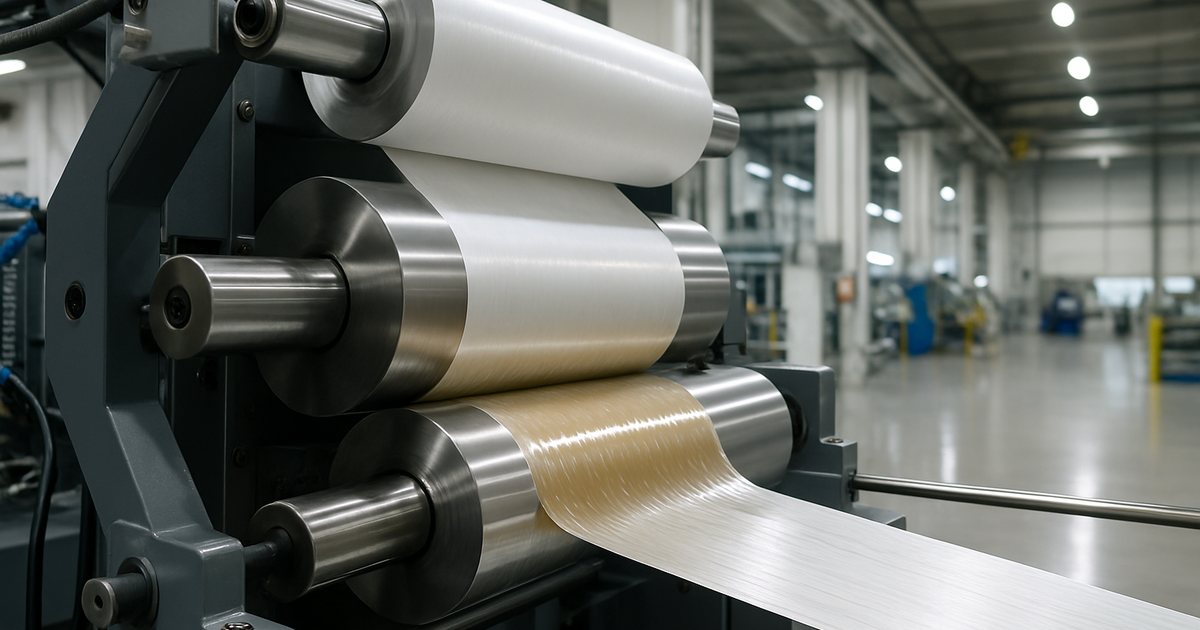
This is the killer advantage. Thermoset composites require a chemical curing reaction that takes 5-60 minutes depending on the resin system and part size. This cannot be accelerated beyond certain limits without compromising cure quality.Thermoplastic composites require only heating (to melt the matrix), forming (in a mold or press), and cooling (to solidify). Total cycle time: 30-120 seconds for stamping/thermoforming, or 5-15 minutes for continuous panel production.
For our CFRT panel production at HOTECH, we produce finished panels at approximately 5-8 linear meters per minute on our continuous lamination line. An equivalent thermoset production line operates at 0.5-1 linear meter per minute.
No Chemical Reaction = Simpler Quality Control
Thermoset composites can suffer from incomplete cure (under-cure), excessive cure (over-cure), and cure-related defects (exothermic hotspots, void formation from volatiles). These quality issues require in-process monitoring and post-cure testing.Thermoplastic composites have no chemical reaction to manage. Quality is determined by temperature (correct melt), pressure (proper consolidation), and cooling rate (crystallization control). These are physical parameters that are easy to measure and control.
Raw Material Storage
Thermoset prepregs must be stored frozen (-18 degrees C) and have limited shelf life (6-12 months). Once thawed, they must be used within hours. This creates significant logistics costs and waste from expired materials.Thermoplastic prepregs and tapes have unlimited shelf life at room temperature. No freezer, no thawing schedule, no expiration. Material waste from storage issues is essentially zero.
The Recyclability Revolution
The composites industry faces an existential sustainability challenge. Thermoset composite waste — from manufacturing offcuts, end-of-life products, and damaged components — is accumulating in landfills worldwide. The European Composites Industry Association (EuCIA) estimates that 30,000-40,000 tonnes of thermoset composite waste is generated in Europe annually, with no economically viable recycling solution.
Thermoplastic composites offer a straightforward solution:
The regulatory landscape is accelerating this transition:
- EU End-of-Life Vehicle Directive: Requires 95% recyclability of vehicle materials by weight. Thermoset FRP panels count toward the 5% non-recyclable allowance — which is rapidly being consumed.
- EU Construction Products Regulation (CPR): Upcoming revisions will include lifecycle environmental assessments that favor recyclable materials.
- Corporate ESG reporting: Major OEMs (automotive, construction) are setting internal targets for recycled and recyclable material content.
When Thermosets Still Win
Despite the advantages of thermoplastics, there are applications where thermoset composites remain the better choice:
High-Temperature Applications
PP-based thermoplastics soften above 80 degrees C, limiting their use in high-temperature environments. Epoxy composites maintain properties to 120-180 degrees C (depending on cure temperature). For engine compartments, exhaust systems, and industrial environments above 100 degrees C, thermoset composites are still necessary. (Note: high-temperature thermoplastics like PEEK handle 250 degrees C+ but at significantly higher cost.)Maximum Static Strength
When absolute strength is the overriding requirement and weight, cycle time, and recyclability are secondary, thermoset epoxy/carbon fiber composites achieve the highest mechanical properties available in any material system. Aerospace primary structures, Formula 1 monocoques, and pressure vessels still use thermoset prepregs.Chemical Processing Equipment
Vinyl ester thermoset composites offer the best chemical resistance across the broadest range of chemicals. For chemical storage tanks, scrubbers, and piping in aggressive chemical environments, vinyl ester FRP remains the standard.Very Low Production Volumes
For prototype quantities and very short production runs (under 50 parts), hand layup of thermoset composites requires minimal tooling investment. Thermoplastic processing typically requires heated tooling that is cost-effective only at higher volumes.Decision Matrix: Thermoplastic vs. Thermoset
| Your Priority | Choose Thermoplastic When... | Choose Thermoset When... |
|---|---|---|
| Production Volume | Medium to high (100+ parts/year) | Low (prototypes, < 50 parts) |
| Cycle Time | Fast production needed (< 2 min) | Cure time acceptable (> 5 min) |
| Impact Resistance | Critical (vehicle bodies, pallets) | Secondary (static structures) |
| Recyclability | Required (automotive, ESG) | Not required |
| Service Temperature | Below 80 C (PP) or below 200 C (PA/PEEK) | Above 100 C |
| Chemical Resistance | Standard (water, oils, mild acids) | Aggressive (concentrated acids, solvents) |
| Repairability | Important (field repair, welding) | Not critical (replace entire part) |
| Worker Safety | VOC-free environment required | Ventilation available |
| Cost Sensitivity | Total cost matters (lifecycle) | Upfront cost matters more |
Our Position: Thermoplastic Is the Future
At HOTECH, we have made a strategic commitment to thermoplastic composite technology. Our entire product line — PP honeycomb core, CFRT panels, MPP insulation panels, and sandwich panels — is based on thermoplastic matrices.
This is not because thermoset composites are bad materials. They are excellent materials that have built the modern composites industry. But for the applications we serve — vehicle bodies, construction panels, logistics packaging — thermoplastic composites offer a superior combination of performance, processing speed, cost, and sustainability.
The trend is clear: the global thermoplastic composites market is growing at 7-9% annually (per Grand View Research and MarketsandMarkets), driven by automotive lightweighting, circular economy mandates, and the push for faster manufacturing. We expect thermoplastic composites to surpass thermoset composites in volume within the next decade in the transportation and construction sectors.
Frequently Asked Questions
Can you convert a thermoset composite design to thermoplastic?
In most cases, yes. The conversion requires re-selecting the resin system (PP, PA, or PET instead of epoxy/polyester), adjusting the fiber reinforcement architecture, and designing new tooling for thermoplastic processing. Mechanical properties need to be re-validated. We provide design assistance for customers looking to transition from thermoset to thermoplastic panels.
Is PEEK a thermoplastic? Why not use it instead of PP?
Yes, PEEK (Polyether Ether Ketone) is a high-performance thermoplastic that handles temperatures up to 250 degrees C and has exceptional mechanical properties. However, PEEK resin costs $80-120/kg compared to $1.5-2.0/kg for PP. This 50-60x cost difference means PEEK is used only in aerospace, medical implants, and extreme industrial applications where performance justifies the cost.
How does welding work for thermoplastic composite repair?
Thermoplastic composites can be welded using hot gas welding, ultrasonic welding, or induction welding. The process involves melting the matrix at the repair interface, pressing the patch material into the melted zone, and allowing it to cool. The welded joint achieves 70-90% of the original material strength. This is the same technology used to repair automotive plastic bumpers and is widely available in body shops.
Do thermoplastic composites creep under sustained load?
Yes, thermoplastic polymers exhibit viscoelastic creep — gradual deformation under constant load over time. For PP-based composites, creep is significant at temperatures above 40 degrees C and loads above 30% of ultimate strength. Panel designs account for this by using safety factors of 3-4x for sustained loads. For applications with constant high loads at elevated temperatures, thermoset composites or engineering thermoplastics (PA, PET) are better choices.
What is the carbon footprint comparison between thermoplastic and thermoset composites?
A lifecycle assessment (LCA) conducted by the European Composites Industry Association found that thermoplastic composites have 20-35% lower cradle-to-grave CO2 emissions than equivalent thermoset composites. The advantage comes from faster processing (less energy per part), zero VOC emissions (no scrubbing systems needed), and end-of-life recyclability (avoided landfill emissions). The exact numbers depend on the specific materials, part size, and production volume.