
Quick Answer
Thermoplastic prepreg is a composite material consisting of continuous fibers (glass, carbon, or aramid) pre-impregnated with a thermoplastic resin matrix (PP, PA, PEEK, or PPS). Unlike thermoset prepreg, thermoplastic prepreg can be reshaped by reheating, welded to other thermoplastic components, and recycled at end of life. CFRT (Continuous Fiber Reinforced Thermoplastic) is the commercial product form — available as unidirectional tapes, woven sheets, and consolidated panels. Processing temperatures range from 180°C (PP-based) to 380°C (PEEK-based).
Thermoplastic vs Thermoset Prepreg
The composites industry historically relied on thermoset prepreg — fibers pre-impregnated with epoxy, polyester, or vinyl ester resins that cure (crosslink) permanently during molding. Once cured, thermoset composites cannot be reshaped, welded, or recycled.
Thermoplastic prepreg uses polymers that melt and resolidify without chemical change. This fundamental difference enables:
| Property | Thermoset Prepreg | Thermoplastic Prepreg |
|---|---|---|
| Processing | Cure once (irreversible) | Melt & resolidify (reversible) |
| Cycle Time | 30-120 minutes (autoclave) | 1-5 minutes (stamp forming) |
| Shelf Life | 6-12 months (frozen storage) | Unlimited (room temperature) |
| Welding | Not possible | Thermal, ultrasonic, induction |
| Recyclability | Not recyclable | Fully recyclable |
| Toughness | Brittle | Tough (10-100x impact energy) |
| VOC Emissions | Significant during cure | Zero (no chemical reaction) |
The shift from thermoset to thermoplastic composites is driven by three forces: faster production cycles (automotive volumes demand seconds-per-part, not hours), sustainability requirements (recyclability mandates in EU and Japan), and the ability to thermally weld components together without adhesives.
How Thermoplastic Prepreg Is Made
Hot Melt Impregnation (Our Primary Method)
This is the most common production method for PP-based and PA-based thermoplastic prepreg. The process:
The entire process runs continuously at 5-15 meters per minute. No solvents, no chemical reactions, no VOC emissions. The factory environment is clean — workers need no respiratory protection.
Film Stacking
An alternative method where dry fiber fabric is layered with thin thermoplastic films. The stack is heated and pressed in a mold or continuous press to melt the films and impregnate the fibers. Simpler equipment than hot melt but slower cycle times and potentially less complete impregnation.
Powder Impregnation
Fine thermoplastic powder is distributed through the fiber tow using fluidized bed or electrostatic deposition, then melted and consolidated. Used for high-performance matrices (PEEK, PPS) where melt viscosity is too high for film or melt impregnation.
CFRT: The Product Form
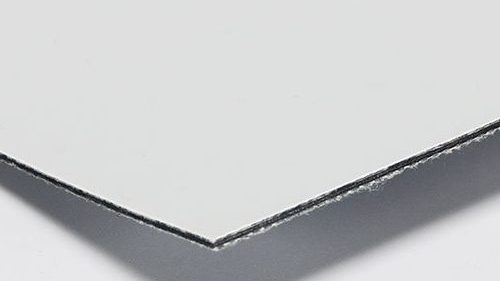
CFRT (Continuous Fiber Reinforced Thermoplastic) is the commercial designation for thermoplastic prepreg products in our panel manufacturing system. We produce CFRT in three forms:
Unidirectional tape (UD tape): Fibers aligned in one direction. Maximum strength along the fiber axis. Used as face sheets for honeycomb sandwich panels and for targeted reinforcement of specific load paths. Cross-ply laminates: Multiple UD tape layers stacked at 0°/90° (or 0°/±45°/90°) and consolidated into a balanced sheet. Provides strength in multiple directions. Woven CFRT sheets: Glass or carbon fiber fabric impregnated with thermoplastic resin and consolidated. Provides equal strength in warp and weft with better drape than cross-ply laminates.Material Properties
| Property | CFRT (Glass/PP) | CFRT (Glass/PA) | CFRT (Carbon/PP) | CFRT (Carbon/PEEK) |
|---|---|---|---|---|
| Fiber Volume | 45-55% | 45-55% | 50-60% | 55-65% |
| Tensile Strength | 400-600 MPa | 500-700 MPa | 800-1,200 MPa | 1,500-2,000 MPa |
| Tensile Modulus | 20-30 GPa | 25-35 GPa | 60-100 GPa | 100-130 GPa |
| Max Temperature | 80°C (continuous) | 120°C | 80°C | 250°C |
| Density | 1.5-1.7 g/cm³ | 1.5-1.7 g/cm³ | 1.3-1.5 g/cm³ | 1.5-1.6 g/cm³ |
| Cost ($/kg) | $3-8 | $5-12 | $20-50 | $100-300 |
Our primary CFRT product is Glass/PP (glass fiber reinforced polypropylene) — it offers the best cost-performance ratio for vehicle body panels, RV construction, and industrial applications. The same PP matrix as our honeycomb core enables thermal bonding without adhesives.
Applications
Vehicle Body Panels
CFRT face sheets on PP honeycomb cores create structural panels for truck walls, floors, and roofs. The panels are stamp-formed at 180-200°C in cycle times of 2-3 minutes — fast enough for medium-volume production (1,000-10,000 units/year). Our CKD truck body kits use CFRT-faced panels exclusively.
Automotive Components
Underbody shields, spare tire covers, and interior structural panels in passenger vehicles. Thermoplastic prepreg enables fast stamp-forming cycles compatible with automotive production volumes. Major OEMs including Volkswagen, BMW, and Toyota use glass/PP thermoplastic prepreg in production vehicles.
RV and Marine
CFRT floor panels with anti-slip textured surfaces replace plywood decking in RVs and boats. The combination of moisture immunity, impact resistance, and anti-slip properties makes CFRT ideal for these environments.
Construction
Fiber-reinforced thermoplastic profiles (CFRT pultruded sections) are emerging as alternatives to fiberglass-reinforced thermoset profiles for window frames, structural beams, and reinforcing bars. The recyclability of thermoplastic profiles is a significant advantage as construction waste regulations tighten.
Processing CFRT: What Fabricators Need to Know
Cutting: Standard carbide-tipped saw blades, water jet, or laser. No special dust extraction needed (thermoplastic does not generate respirable fibers like thermoset grinding). Joining: Thermal welding (hot plate, infrared, laser), ultrasonic welding, or induction welding. No adhesives needed for PP-to-PP joints. Mechanical fastening (bolts, rivets) also works. Thermoforming: Heat CFRT sheet to 180-200°C (Glass/PP) and form in a matched die press. Cycle time: 30-90 seconds per part. Reheating and reforming is possible for design iterations or recycling. Surface treatment: CFRT surfaces accept painting, printing, and adhesive bonding after corona or flame treatment to improve surface energy.Frequently Asked Questions
What is the difference between prepreg and CFRT?
Prepreg is the generic term for fiber pre-impregnated with resin — it can be thermoset or thermoplastic. CFRT specifically refers to continuous fiber reinforced thermoplastic products. All CFRT is thermoplastic prepreg, but not all prepreg is CFRT.
Does thermoplastic prepreg need refrigerated storage?
No. Thermoplastic prepreg is fully polymerized and chemically stable at room temperature. It has unlimited shelf life stored in a dry environment. This is a major advantage over thermoset prepreg, which must be stored at -18°C and has a shelf life of 6-12 months.
Can CFRT be recycled?
Yes. CFRT can be reground and reprocessed as long-fiber reinforced thermoplastic pellets for injection molding. The mechanical properties of the recycled material are lower than virgin CFRT but suitable for non-structural parts. Our production scrap is 100% recycled on-site.
What fiber volume fraction is optimal?
For structural panels, 45-55% fiber volume provides the best balance of strength, processability, and cost. Higher fiber volumes (60%+) increase stiffness but make impregnation more difficult and can lead to dry spots. Lower fiber volumes waste matrix material without proportional property gains.
How does CFRT compare to aluminum sheet?
A 1mm CFRT sheet (Glass/PP, 1.6 g/cm³) weighs 1.6 kg/m² and has a tensile modulus of 20-30 GPa. A 1mm aluminum sheet (2.7 g/cm³) weighs 2.7 kg/m² and has a modulus of 70 GPa. CFRT is 40% lighter but less stiff per unit thickness. For stiffness-critical applications, CFRT is used as face sheets on honeycomb cores — the sandwich construction achieves much higher stiffness-to-weight ratios than either material alone.
Related Guides
- CFRT Panel (Continuous Fiber Reinforced Thermoplastic): Complete Guide
- Thermoplastic vs Thermoset Composites: Which Is Right for You?
- CFRT vs FRP vs Aluminum: Composite Panel Comparison
- Fiberglass Cloth & Tape: Types & Selection Guide
- PP Honeycomb Panel: Properties & Manufacturing Guide
Source CFRT Products
We manufacture CFRT tapes, sheets, and honeycomb sandwich panels at our production facility in Tongxiang, Zhejiang. Contact us for material specifications, test data, and samples.

![PP Honeycomb Panel — Properties, Applications & How It's Made [2026]](/images/products/pp-honeycomb-panel.jpg)