Quick Answer
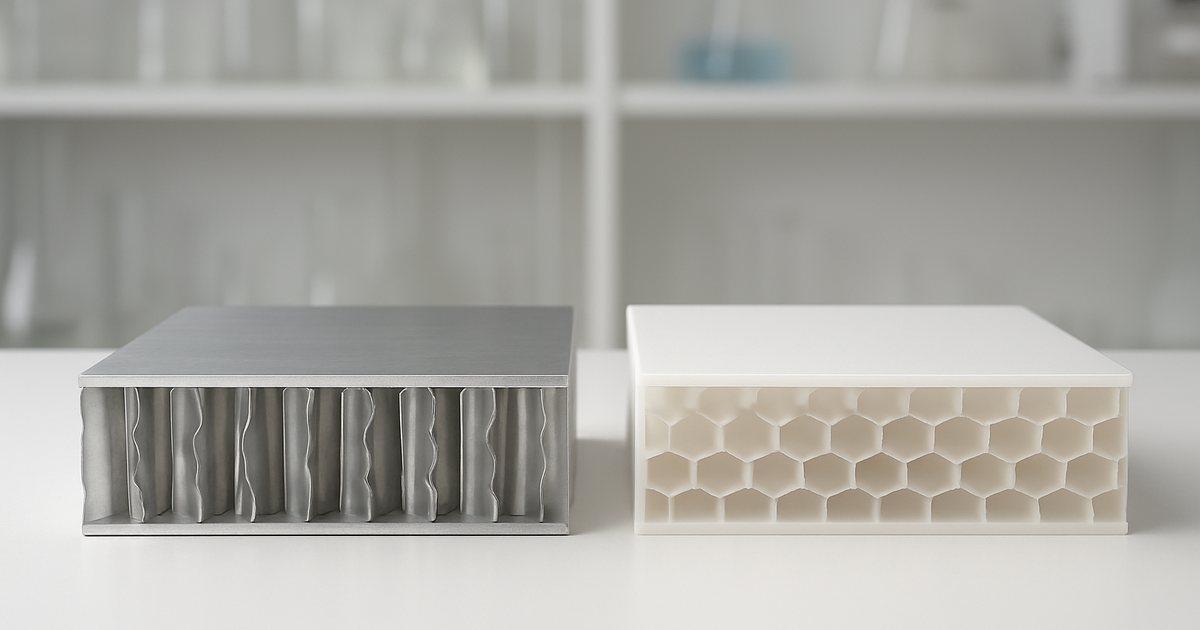
Lightweight honeycomb panels achieve strength-to-weight ratios 3-10x higher than solid materials by separating two thin, strong face sheets with a low-density cellular core. A 20mm PP honeycomb panel weighing 2.5 kg/m² can replace 18mm plywood at 10 kg/m² in most structural applications — a 75% weight reduction. The key design decisions are core material (PP, aluminum, Nomex, foam), cell size, and face sheet type.
How Honeycomb Panels Achieve Light Weight
The engineering principle behind honeycomb panels is identical to structural I-beams. In an I-beam, the top and bottom flanges carry bending loads (tension and compression) while the thin web maintains the spacing between them. In a honeycomb panel, the face sheets are the flanges and the honeycomb core is the web.
Bending stiffness increases with the cube of panel thickness. This means doubling the core thickness makes the panel 8x stiffer while adding minimal weight — because the core is mostly air. A solid 2mm aluminum sheet and a 20mm honeycomb panel with 0.5mm aluminum face sheets have similar weight, but the honeycomb panel is roughly 37x stiffer in bending.
This is why lightweight honeycomb panels dominate in applications where stiffness, flatness, and low weight are critical: vehicle bodies, aircraft interiors, furniture panels, signage, and construction partitions.
Core Material Options
| Core Type | Density (kg/m³) | Temp Range (°C) | Water Resistance | Cost | Best For |
|---|---|---|---|---|---|
| PP Honeycomb | 40-80 | -40 to +80 | Excellent (0% absorption) | $ | Vehicles, construction, packaging |
| Aluminum Honeycomb | 29-130 | -55 to +180 | Moderate (can corrode) | $$$ | Aerospace, high-temp, defense |
| Nomex Honeycomb | 29-128 | -55 to +180 | Poor (absorbs moisture) | $$$$ | Aerospace, racing |
| PU Foam | 30-80 | -30 to +100 | Moderate | $$ | Insulation panels |
| PET Foam | 60-200 | -60 to +130 | Good | $$ | Marine, wind energy |
| XPS Foam | 25-45 | -50 to +75 | Good | $ | Cold storage, insulation |
PP (polypropylene) honeycomb is the most cost-effective option for ground-level applications. It provides the best combination of light weight, moisture resistance, impact tolerance, and recyclability at the lowest cost per square meter.
Cell Size and Its Effect on Performance
Cell size is the diameter of the individual hexagonal cells in the honeycomb core. Smaller cells pack more material into the same volume, producing a denser, stronger core. Larger cells use less material for a lighter, less expensive core.
| Cell Size | Core Density (approx.) | Compressive Strength | Weight | Applications |
|---|---|---|---|---|
| 6mm | 70-80 kg/m³ | >1.5 MPa | Heaviest | Heavy-load floors, forklift areas |
| 8mm | 55-65 kg/m³ | 1.0-1.5 MPa | Standard | Vehicle walls, RV panels, general |
| 12mm | 40-50 kg/m³ | 0.6-1.0 MPa | Light | Interior partitions, furniture |
| 19mm | 25-35 kg/m³ | 0.3-0.6 MPa | Very light | Signage, display boards |
| 25mm | 18-25 kg/m³ | 0.2-0.4 MPa | Lightest | Ceiling panels, acoustic barriers |
We produce PP honeycomb cores in all five cell sizes at our factory in Tongxiang, Zhejiang. Custom cell sizes between 5mm and 30mm are available for orders above 500 m².
Face Sheet Options
The face sheets determine the panel's surface properties, appearance, and bending strength:
- Fiberglass-reinforced PP: The workhorse option. Strong, lightweight, bondable. Our standard face sheet for structural applications.
- PET non-woven fabric: Economical, lightweight. Used for interior panels, packaging, and applications where high surface strength is not required.
- CFRT (continuous fiber reinforced thermoplastic): Premium option with the highest flexural strength. Available in anti-slip textured, smooth white, and black finishes.
- Aluminum sheet: For applications requiring metallic appearance or EMI shielding. Bonded to PP honeycomb core using structural adhesive or thermal lamination.
- HPL (High Pressure Laminate): Decorative surfaces — woodgrain, stone, solid colors. Used in furniture and architectural applications.
- Stone veneer: Ultra-thin natural stone (1-3mm) bonded to honeycomb core for lightweight stone facades. An 800x1200mm stone-faced honeycomb panel weighs 5 kg versus 60+ kg for solid stone.
Applications by Industry
Vehicle Bodies (Trucks, Trailers, Buses)
Lightweight honeycomb panels reduce vehicle body weight by 40-60% compared to steel or plywood construction. For a 4.2m dry freight truck body, this means 200-350 kg saved, translating directly to increased payload and reduced fuel consumption. Our CKD truck body kits ship flat-packed and assemble on site without welding equipment.
RV and Motorhome Manufacturing
Floor panels, wall panels, and roof panels for RVs benefit from the unique combination of light weight, moisture immunity, and thermal insulation provided by honeycomb air cells. PP honeycomb eliminates the delamination failures that plague traditional plywood-based RV construction.
Construction and Architecture
Partition walls, ceiling panels, door cores, and facade elements. A honeycomb-cored partition wall weighs 3-5 kg/m² versus 10-15 kg/m² for drywall-on-stud construction. Stone-faced honeycomb panels enable large-format stone facades on buildings without massive structural support.
Furniture and Interior Design
Table tops, shelving, cabinet doors, and display panels. Honeycomb-cored furniture panels weigh 70-80% less than particleboard or MDF equivalents while maintaining flatness and rigidity. IKEA's flat-pack furniture has used paper honeycomb cores for decades — PP honeycomb is the moisture-resistant upgrade.
Logistics and Packaging
Reusable pallets, flight cases, aviation containers, and dunnage. PP honeycomb pallets weigh 4-6 kg versus 20-25 kg for wooden pallets and are exempt from ISPM 15 fumigation requirements for international shipping.
Design Guidelines
Panel thickness selection: For wall panels with frame support at 400-600mm spacing, 12-15mm thickness is adequate. For self-supporting spans above 600mm, use 20-25mm. For floor panels under point loads (furniture, people), use 20-30mm with 6mm or 8mm cell core. Edge treatment: Cut edges expose the honeycomb core. For waterproof applications, seal edges with aluminum U-channel, plastic edge trim, or hot-melt sealant. For interior applications, edge trim provides a finished appearance. Fastening: PP honeycomb panels accept self-tapping screws (pilot hole recommended), blind rivets, and structural adhesives. Pull-out strength for a 5mm self-tapping screw in a 15mm panel: 800-1,200 N depending on core density.Frequently Asked Questions
How flat are honeycomb panels?
Our PP honeycomb panels achieve flatness within ±1mm per meter of panel length — comparable to precision-ground MDF. The continuous thermal lamination process ensures consistent thickness and flatness across the entire panel area.
Can honeycomb panels be curved?
PP honeycomb panels can be cold-bent to radii down to approximately 50x the panel thickness (e.g., a 10mm panel bends to 500mm radius). For tighter radii, thermoforming at 140-160°C allows complex 3D shapes. Aluminum honeycomb cannot be thermoformed.
What is the maximum panel size you produce?
Our production line handles panels up to 2,440mm wide and 12,000mm long. Larger panels can be produced by edge-joining standard-width panels with aluminum H-profiles or thermal welding.
How do honeycomb panels perform acoustically?
The air cells in the honeycomb core provide moderate sound absorption. For enhanced acoustic performance, panels with micro-perforated face sheets allow sound energy to enter the honeycomb cells, where it is absorbed through viscous friction. Our acoustic honeycomb panels achieve NRC (Noise Reduction Coefficient) values of 0.4-0.7 depending on panel thickness and perforation pattern.
Are lightweight honeycomb panels recyclable?
PP honeycomb panels are 100% recyclable in standard polypropylene recycling streams. The mono-material construction (PP core + PP-based face sheets) means no separation of dissimilar materials is needed before recycling. This is a significant advantage over aluminum honeycomb panels, which require mechanical separation of aluminum core from non-aluminum face sheets.
Related Guides
- PP Honeycomb Panel: Properties, Applications & Manufacturing Guide
- Honeycomb Core Panel: Structure, Types & Performance Data
- Aluminum Honeycomb vs PP Honeycomb: Which Core Should You Choose?
- Sandwich Panel Construction: Core Materials, Skins & Bonding Methods
- Truck Body Composite Panels: Reducing Weight, Increasing Payload
Lighten Your Product
Whether you build vehicles, furniture, buildings, or packaging — PP honeycomb panels can reduce your product weight by 40-75% while maintaining or improving structural performance. Contact us for engineering support and free samples.
![PP Honeycomb Panel — Properties, Applications & How It's Made [2026]](/images/products/pp-honeycomb-panel.jpg)