
Quick Answer
For an ATP FRC-class refrigerated truck body (frozen goods down to -20 degrees C), the whole-body heat transfer coefficient must be K <= 0.40 W/m2K. In practice that means a sandwich panel with 75-100mm of insulation core, a fully sealed FRP or CFRT skin, and — this is the part most buyers miss — a joint and floor design that does not leak heat through thermal bridges. Polyurethane (PU) wins on day-one lab numbers. Extruded polystyrene (XPS) and micro-foamed polypropylene (MPP) win on year-seven real numbers, because they do not absorb water and their thermal conductivity does not drift.
This guide gives you the actual numbers: lambda values, required thicknesses, panel weights, indicative FOB pricing, and the specification checklist we use when quoting CKD refrigerated truck bodies.
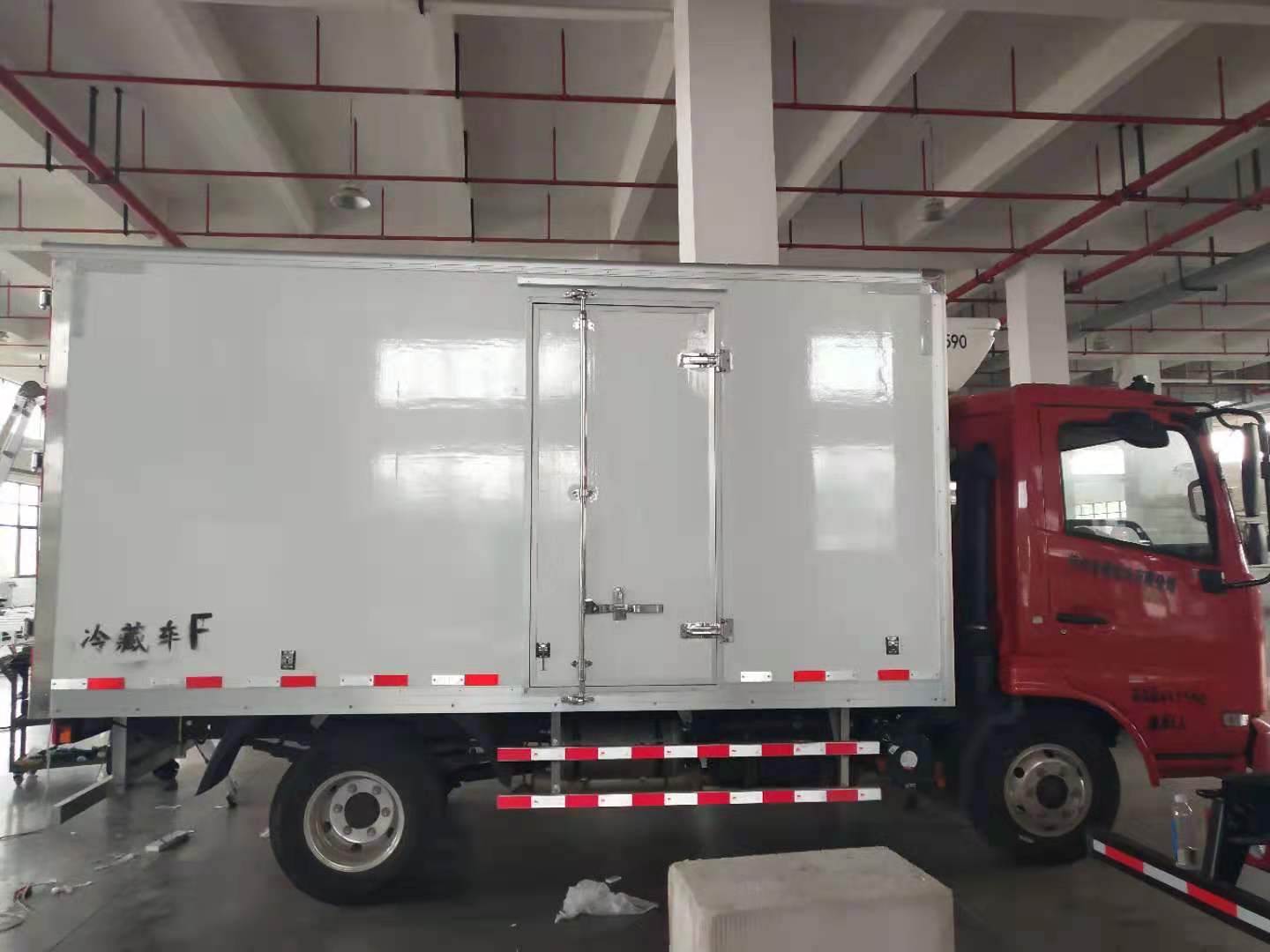
What a Reefer Panel Actually Has to Do
Buyers usually specify a refrigerated body by describing what goes inside it: ice cream, fresh produce, vaccines, chilled meat. Engineers specify it by a single number — the K coefficient (also written as K-value), which measures how much heat leaks through one square metre of the body envelope per degree of temperature difference.
The ATP Agreement (Agreement on the International Carriage of Perishable Foodstuffs) defines the classes:
| ATP Class | Meaning | K Requirement | Internal Temp Range |
|---|---|---|---|
| IN (normally insulated) | Insulated only | K <= 0.70 W/m2K | No mechanical unit |
| IR (heavily insulated) | Reinforced insulation | K <= 0.40 W/m2K | No mechanical unit |
| FNA | Mechanically refrigerated, normal insulation | K <= 0.70 W/m2K | 0 to +12 degrees C |
| FRB | Mechanically refrigerated, reinforced | K <= 0.40 W/m2K | -10 to +12 degrees C |
| FRC | Mechanically refrigerated, reinforced | K <= 0.40 W/m2K | -20 to +12 degrees C |
Two things to understand about K:
So the real engineering target is not "pass the K test," it is "still pass the K test in nine years."
The Four Core Materials, With Real Numbers
Here is where every competitor article stops at adjectives. These are the values we design around:
| Property | PU Foam | PIR Foam | XPS | MPP (micro-foamed PP) |
|---|---|---|---|---|
| Lambda, initial (W/mK) | 0.022-0.024 | 0.022-0.025 | 0.028-0.034 | 0.035-0.040 |
| Lambda, after 5-7 yrs service | 0.028-0.032 | 0.027-0.030 | 0.030-0.035 | 0.035-0.040 (stable) |
| Water absorption, 24h (vol %) | 1.0-3.0% | 1.0-2.0% | <= 0.3% | < 0.1% |
| Core density (kg/m3) | 40-45 | 32-45 | 30-38 | 60-100 |
| Compressive strength (kPa) | 150-250 | 150-250 | 250-700 | 400-900 |
| Max service temp | +80 degrees C | +110 degrees C | +75 degrees C | +80 degrees C |
| Fire behaviour | Combustible, needs FR | Better char, self-extinguishing | Combustible | Combustible, FR grades available |
| Food-contact safe | Requires liner | Requires liner | Requires liner | Yes, direct food contact grade |
| Recyclable at end of life | No (thermoset) | No (thermoset) | Limited | 100% (thermoplastic) |
| Blowing agent drift | Yes, significant | Yes, moderate | Minimal | None (supercritical CO2) |
But lambda is not a constant. PU is foamed with hydrocarbon or HFO blowing agents that slowly diffuse out and are replaced by air — the well-documented ageing effect that pushes PU from 0.022 toward 0.030 over the first five to seven years. Add water ingress at cut edges and screw penetrations (PU is an open enough cell structure that a compromised edge wicks moisture into the panel) and the degradation accelerates. A PU reefer body that measured K = 0.32 when new commonly measures K = 0.42-0.48 at its second renewal — a failed certificate and a body that now needs re-panelling.
XPS is a closed-cell extruded foam with essentially no blowing-agent drift after the first year and water absorption at or below 0.3% by volume. It starts worse and ends better. That is why, in European reefer construction, FRP-skinned XPS panels are the dominant build even though PU has the better brochure number.
MPP — our micro-foamed polypropylene insulation panel — is the newest of the four. It is produced by dissolving supercritical CO2 into molten polypropylene and releasing it to nucleate a uniform micro-cellular structure. Its lambda is honestly the highest of the four at 0.035-0.040 W/mK, and we do not pretend otherwise. What it buys you in exchange:- Zero ageing. The cells contain air, not a diffusing blowing agent. The lambda you measure in year one is the lambda you measure in year ten.
- Water absorption under 0.1%. The lowest of any core in this table.
- Direct food-contact certification. No separate liner needed, no outgassing, no VOC.
- Compressive strength of 400-900 kPa — roughly two to four times PU, which matters enormously for floors that take pallet jacks and forklift tines.
- 100% recyclable as a single-polymer system when the skins are also PP-based, which is where EU end-of-life vehicle regulation is heading.
How Thick Does the Panel Actually Need to Be?
Start from the flat-panel calculation. For a homogeneous core the panel U-value is approximately:
U = lambda / dwhere d is core thickness in metres. To hit the FRC target of 0.40 W/m2K on the flat panel alone:
| Core | Design lambda (end-of-life) | Thickness for U = 0.40 | Thickness we recommend |
|---|---|---|---|
| PU foam | 0.030 | 75mm | 90-100mm |
| PIR foam | 0.029 | 73mm | 85-100mm |
| XPS | 0.032 | 80mm | 100mm |
| MPP | 0.038 | 95mm | 110-120mm |
Now the correction nobody publishes: the assembled body K is typically 15-25% worse than the flat-panel calculation. Corner extrusions, door frames, floor rails, rear frame, and the evaporator penetration are all thermal bridges. That is why the "thickness we recommend" column adds margin — designing the flat panel to exactly 0.40 guarantees the body fails.
Two further rules from our production floor:
- The floor is not the same as the walls. Floors need higher compressive strength and take the most abuse, so we typically run the floor 20-30mm thicker than the walls and step up the core density.
- Doors are the weakest element in almost every reefer. A perfect 100mm wall next to a 60mm door with a single seal will dominate your K result. Doors should be the same core thickness as the walls, with double perimeter seals.
Face Sheet Selection: FRP vs CFRT vs Metal
The core does the insulating; the skin does the sealing, the abuse resistance, and the hygiene.
| Skin | Thickness | Strength | Repairability | Vapour Barrier | Relative Cost |
|---|---|---|---|---|---|
| FRP / GRP gelcoat | 1.5-2.5mm | Good | Excellent (patch kit) | Good | 1.0x |
| CFRT (glass/PP tape) | 0.8-1.5mm | Very good | Weldable, no resin | Excellent | 1.1-1.3x |
| Stainless steel | 0.5-0.8mm | Excellent | Difficult | Excellent | 2.0-2.5x |
| Aluminium sheet | 0.8-1.2mm | Moderate | Moderate | Excellent | 1.4-1.8x |
| Pre-painted galvanised | 0.5-0.7mm | Good | Poor (corrosion at cuts) | Good | 0.9x |
For food transport, FRP with a white food-grade gelcoat remains the workhorse — it is cheap, easy to clean, easy to patch after a forklift strike, and has 40 years of field history.
Our own preference for lightweight builds is CFRT skins — continuous glass fibre tapes consolidated in a polypropylene matrix. CFRT delivers comparable puncture resistance at roughly 40% less skin weight than FRP, it thermally welds to a PP or MPP core without any adhesive (so there is no adhesive layer to hydrolyse), and it makes the whole panel a single-polymer recyclable system. The trade is that it cannot be gelcoat-repaired in the field the way FRP can; it is repaired by heat welding a patch.
For a fuller treatment of skin and core pairing, see our sandwich panel construction guide.
Where Reefer Bodies Actually Fail
In ten years of building panels for vehicle bodies, we see the same five failures repeatedly. None of them are the flat panel.
1. Cut edges left open. Every time a panel is trimmed on site, the core is exposed. On PU, an unsealed edge wicks water continuously. This single mistake is responsible for more failed ATP renewals than any material choice. Every cut edge must be sealed — routed back 3-5mm and filled, or capped with a bonded profile. 2. Fasteners driven straight through the panel. A screw through the skin into the core creates both a mechanical weak point and a moisture path. Loads must go into bonded inserts or through-bolts with backing plates, not into foam. 3. Metal-to-metal thermal bridges at corners. Aluminium corner extrusions that run continuously from inside skin to outside skin are, thermally, a hole in your body. Corner profiles need a thermal break — a polymer isolation strip in the extrusion path. 4. Floor rail penetration. Load-securing rails and e-track bolted through the floor into the chassis create a bridge and a leak path. They should mount into pre-installed hardwood or high-density PP blocks laminated into the panel at the factory. 5. Door seal degradation. Seals compress permanently and lose recovery. On a body used 300 days a year at 20+ door cycles per day, seals are a 3-4 year consumable, not a lifetime part.Cost, Weight and the Payload Argument
The number that actually persuades a fleet operator is payload. Here is the comparison we run for a 4.2m rigid reefer body:
| Build | Wall/roof panel | Body tare weight | Payload gain | Indicative FOB panel price |
|---|---|---|---|---|
| Steel frame + PU + FRP (traditional) | 75mm | 1,150-1,350 kg | baseline | USD 30-42 / m2 |
| FRP + XPS, framed | 100mm | 980-1,150 kg | +180 kg | USD 38-52 / m2 |
| CFRT + MPP, frameless CKD | 110mm | 720-880 kg | +400-450 kg | USD 42-65 / m2 |
Panel prices are indicative FOB Shanghai/Ningbo for volume orders and vary with skin specification, core density, colour and panel size. Complete CKD refrigerated body kits for a 4.2m rigid typically land in the USD 3,800-6,500 range per unit depending on door configuration, floor build, and whether the refrigeration unit is included.
On payload: 400 kg of additional legal payload on a distribution vehicle running 250 days a year is not a rounding error. At a typical European chilled distribution rate, it is the difference between 11 and 12 roll cages per drop cycle. Our truck body payload analysis works through the full arithmetic.
MOQ for standard reefer panel specifications is 200 m2; custom core densities, non-standard skins or bespoke colours carry a 500 m2 MOQ. Sample panels of 300 x 300mm are supplied free for material evaluation. Lead time for standard panels is 15-20 days; CKD body kits are 30-45 days.
Specification Checklist Before You Order
Send your supplier this list. If they cannot answer all of it, they are a trader, not a manufacturer.
- Target ATP class (IN / IR / FNA / FRB / FRC) and required K value
- Core material, core density in kg/m3, and declared lambda with the test standard (EN 12667 or ASTM C518)
- Declared water absorption per EN 12087 or ASTM C272
- Skin material, skin thickness, and gelcoat thickness if FRP
- Panel thickness for wall / roof / floor separately
- Floor compressive strength and point-load rating (pallet jack wheel load)
- Thermal break detail at all corner and door-frame extrusions
- Factory-installed insert and hardwood block positions
- Edge-sealing method for all field-cut edges, with supplied sealing kit
- Food-contact certification for any surface in contact with unpackaged product
- Fire classification if required by destination market
- ATP test report or a calculation sheet showing predicted whole-body K
How We Build Reefer Panels at HOTECH
Our reefer panel line runs from raw polypropylene pellet to finished panel in one facility in Tongxiang, Zhejiang — 50,000+ m2, 31 patents, 100 staff. The micro-foaming, skin production and lamination all happen in-house, which is why we can certify the lambda and the food-contact status of the finished panel rather than passing along a supplier's data sheet.
The build we recommend for FRC-class work:
- Core: MPP micro-foamed PP, 110mm walls and roof, 130mm floor, 80 kg/m3 wall density and 100 kg/m3 floor density
- Skins: CFRT glass/PP, 1.2mm exterior, 1.0mm interior, thermally welded — no adhesive layer
- Corners: PP corner profiles with integral thermal break, welded not bolted
- Floor: MPP core with laminated PP load blocks on 400mm centres for e-track
- Format: CKD flat-pack, container-shipped, assembled on site in one to two days by two people
Frequently Asked Questions
Is PU or XPS better for a refrigerated truck body?
PU has the better initial thermal conductivity — 0.022 W/mK versus 0.028-0.034 for XPS — so a PU body can hit the same K value in a thinner panel. XPS has water absorption at or below 0.3% versus 1-3% for PU, and does not suffer blowing-agent drift, so it holds its performance far better over a 10-year service life. If you are buying a body to sell in three years, PU is cheaper and lighter. If you are buying a body to run for ten years and renew its ATP certificate twice, XPS or MPP will cost you less in total. Roughly 80% of European reefer bodies use XPS cores for exactly this reason.
What panel thickness do I need for ATP FRC certification?
Design the flat panel to a U-value of about 0.30-0.32 W/m2K, not 0.40, because the assembled body typically measures 15-25% worse than the flat panel due to thermal bridging at corners, door frames and floor rails. In practice that means 90-100mm of PU, 100mm of XPS, or 110-120mm of MPP for walls and roof, with the floor 20-30mm thicker. Doors must match the wall thickness — a thin door will dominate your K result no matter how good the walls are.
What is the MOQ and lead time for refrigerated truck body panels?
Standard specifications carry a 200 m2 MOQ with a 15-20 day lead time. Custom core density, non-standard skin materials or bespoke colours require 500 m2 and 25-30 days. Complete CKD refrigerated body kits have a MOQ of one unit for evaluation, though container economics favour orders of three or more units. Free 300 x 300mm sample panels are available for material testing before you commit.
Can refrigerated panels be repaired in the field after damage?
Yes, and the repair method depends on the skin. FRP skins are repaired with a standard gelcoat and chopped-strand patch kit — a competent technician restores both the structure and the vapour barrier in a few hours. CFRT skins are repaired by heat-welding a matching PP patch, which is faster and needs no resin chemistry, but requires a hot-air welding tool. In both cases the critical step is sealing the core: if the core is exposed and wet, it must be dried and the wet section cut out before patching, or the moisture will migrate through the panel.
How much weight does a composite reefer body save versus a steel-framed one?
A frameless CFRT/MPP composite body for a 4.2m rigid typically has a tare weight of 720-880 kg against 1,150-1,350 kg for a traditional steel-framed PU/FRP build — a saving of roughly 400-450 kg, which converts directly into legal payload. On a chilled distribution route running 250 days a year, that is one to two additional roll cages per trip.
Do you need a separate food-safe liner inside the body?
With PU, PIR or XPS cores, yes — the core materials are not food-contact certified, so the interior skin must provide a certified barrier, usually a food-grade FRP gelcoat or a stainless liner. MPP micro-foamed polypropylene is produced in a direct food-contact grade with no blowing-agent residue and no VOC outgassing, so it does not need a separate liner. This matters most in bodies carrying unpackaged product such as bulk meat, fish or bakery goods.
How long does an ATP certificate last?
The initial ATP certificate is valid for six years from the date of the first test. After that, it is renewed every three years, either by inspection of the body by an authorised expert or by re-test in an ATP test station. Bodies most commonly fail at the nine-year or twelve-year renewal, and the cause is almost always moisture accumulation in the insulation core rather than any structural problem.
Related Guides
- Sandwich Panel Construction: Core Materials, Skins & Bonding Methods
- Truck Body Composite Panels: Reducing Weight, Increasing Payload
- CKD Truck Bodies: The Complete Guide to Modular Flat-Pack Assembly
- RV Insulation Materials Compared: MPP vs Polyurethane vs XPS vs Fiberglass
- How to Choose a Composite Panel Manufacturer in China
Get a Reefer Panel Specification
Send us your ATP class target, body dimensions, operating temperature range and destination market, and our engineering team will return a panel specification with a predicted whole-body K calculation, panel weights, and an FOB quotation — usually within two working days.
Request a Quote or browse our MPP insulation panels and CKD refrigerated bodies.
![PP Honeycomb Panel — Properties, Applications & How It's Made [2026]](/images/products/pp-honeycomb-panel.jpg)
