
Why van builders use Baltic birch — and where it fails
Baltic birch plywood became the default material in the van conversion industry for good reasons. Its cross-laminated birch veneers — 13 layers in a 18 mm sheet versus 5–7 in commodity plywood — give it excellent screw holding, dimensional stability and stiffness. At a density of 650–720 kg/m³, it is strong enough to support cabinetry, appliances and occupant loads without flex.
But Baltic birch has three weaknesses that matter in a vehicle that lives outdoors:
Moisture. Baltic birch absorbs water. The cross-lamination and phenol-formaldehyde glue make it better than standard plywood, but a 12 mm sheet still absorbs 2–6% of its weight in water over 24 hours of immersion per ASTM D570 testing. In a van, road spray enters through wheel wells and floor seams, condensation forms between insulation layers overnight, and coffee gets spilled on Monday. Over 3–5 years the edges swell, the surface delaminates under vinyl flooring, and in warm climates you get mould between the plywood and the van floor. Weight. A 12 mm Baltic birch sheet at 4×8 ft weighs approximately 22 kg (48 lb). A Sprinter 170 floor takes roughly 1.5 sheets = 33 kg (73 lb) in subfloor alone. Add 12 mm for cabinet boxes, shelving, bed platform and overhead storage, and Baltic birch can easily add 80–100 kg (176–220 lb) to the build. That weight reduces payload capacity, increases fuel consumption, and on a ProMaster with a 1,400 kg payload rating it competes directly with the water tank, battery bank and passengers. Thickness trade-off. Van builders commonly use 12 mm for floors and cabinets and 15 mm for furniture panels. Going thinner saves weight but introduces flex underfoot, especially over the corrugated metal van floor. You end up choosing between weight and rigidity — a trade-off that a honeycomb sandwich panel eliminates.What CFRT honeycomb panels are and how they differ
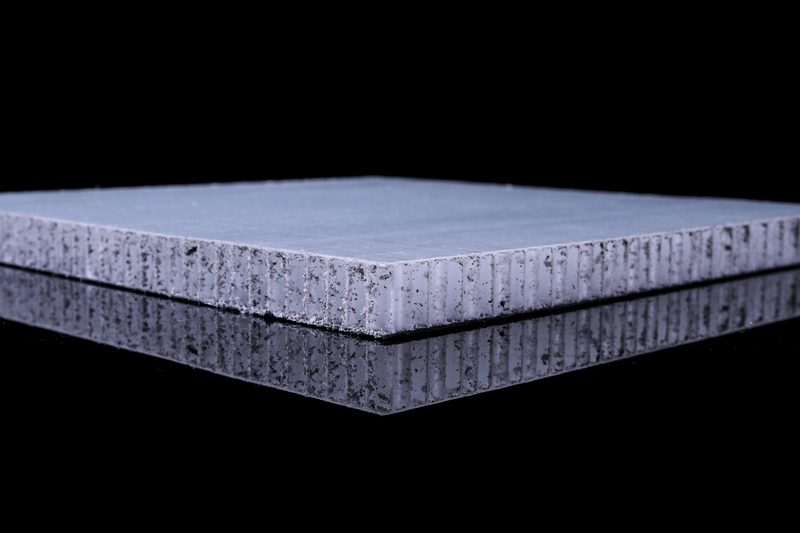
CFRT stands for continuous-fibre reinforced thermoplastic — a facing material where long glass or carbon fibres run continuously through a polypropylene or nylon matrix, then get pressed onto a PP honeycomb core. The result is a sandwich panel: two stiff CFRT skins bonded to a lightweight honeycomb core.
This is not the same construction as Coosa boards (polyurethane foam + chopped-fibre glass) or XPS foam boards (polystyrene with no structural skin). The honeycomb geometry gives the panel its stiffness-to-weight ratio — the same principle used in aircraft floors and Formula 1 monocoque tubs, manufactured at an industrial scale for truck bodies and commercial vehicles.
Three properties matter for van conversions: the panel is light (2.5–4.0 kg/m² depending on thickness and skin configuration), it absorbs virtually no water (<0.1% by weight, because closed-cell PP does not swell, rot or wick moisture), and it is available in smooth, anti-slip, or paintable surfaces without additional finishing.
Head-to-head: weight by application
The following table compares materials at thicknesses commonly used in van conversions. All weights are per square metre of finished panel.
| Application | Typical thickness | Baltic birch (kg/m²) | CFRT honeycomb (kg/m²) | Weight saving |
|---|---|---|---|---|
| Subfloor | 12 mm | 7.2 | 2.8 | 61% |
| Cabinet sides & shelving | 12 mm | 7.2 | 2.8 | 61% |
| Furniture panels / doors | 15 mm | 9.0 | 3.2 | 64% |
| Wall lining / headliner | 6–9 mm | 4.3–5.4 | 1.8–2.2 | 58–59% |
| Bed platform | 18 mm | 10.8 | 3.6 | 67% |
Baltic birch density: 680 kg/m³ (mid-range). CFRT honeycomb data from HOTECH production specifications, 2026.
For a typical Sprinter 170 conversion with a full kitchen, fixed bed, overhead cabinets and wall panelling, switching every Baltic birch panel to CFRT honeycomb saves approximately 55–75 kg (121–165 lb). On a Transit or ProMaster, that is the equivalent of carrying an extra passenger or adding a 75-litre freshwater tank without exceeding GVWR.
Need a panel specification for your van platform? Request a free sample →
Moisture resistance: the real long-term difference
This is where the two materials diverge most sharply, and where van builders discover the problem 2–3 years into ownership.
| Property | Baltic birch plywood | CFRT honeycomb panel | Test method |
|---|---|---|---|
| Water absorption (24 h immersion) | 2–6% by weight | <0.1% by weight | ASTM D570 |
| Edge swell (24 h immersion) | 1–3% thickness increase | No measurable change | ASTM D1037 |
| Mould growth in humid environment | Susceptible (cellulose substrate) | Not susceptible (inert PP) | ASTM G21 |
| Freeze-thaw degradation | Delamination risk after repeated cycles | No effect (thermoplastic matrix) | — |
| Food-contact safety | Requires sealing | Available in food-grade finishes | FDA 21 CFR 177.1520 |
In practical terms: if you spill water under your vinyl floor and do not notice it for a week, Baltic birch will swell at the edges and telegraph the bump through the vinyl. A CFRT panel will not change dimensionally. If road salt spray enters through the rear door seal over winter, Baltic birch wicks it along the grain and the damage spreads; PP honeycomb has no grain and no capillary structure.
This matters especially for vinyl plank and sheet vinyl subfloors. Manufacturers like Lonseal specify a smooth, dry, dimensionally stable substrate — any surface imperfection shows through a one-sheet vinyl installation. A CFRT panel with a smooth white surface meets that requirement out of the box, without sanding, sealing or priming.
Stiffness and deflection: will it flex underfoot?
Van builders worry that a lighter panel will feel "bouncy" underfoot. Here is the mechanical reality:
A sandwich panel's bending stiffness scales with the cube of the distance between the skins, not with the material density. A 12 mm CFRT honeycomb panel with 0.5 mm CFRT skins has a higher flexural rigidity per unit weight than 12 mm solid Baltic birch, because the skins carry the bending load and the core carries the shear load — the same structural logic as an I-beam.
In practice, on a corrugated Sprinter floor with insulation strips between the ribs, a 12 mm CFRT panel supported every 300 mm by the corrugations feels stiffer underfoot than 12 mm Baltic birch, because the sandwich construction resists point loads better than a homogeneous sheet. For wider unsupported spans — like a flat ProMaster floor — step up to 15 mm or 18 mm CFRT and the span capability increases faster than it would with plywood.
For the technical data behind the deflection calculation, see our lightweight composite panels engineering guide.
Screw holding and cabinet joinery
This is the one area where Baltic birch has a genuine, measurable advantage over bare composite panels — and the one most builders ask about first.
A #10 wood screw in 12 mm Baltic birch withdraws at approximately 930–1,130 N (209–254 lbf) per the USDA Wood Handbook side-grain equation with the plywood penalty applied. A self-tapping screw into a 0.5 mm CFRT skin engages roughly one thread and cannot match that.
The solution is not to avoid composite panels — it is to design the joint correctly:
- Through-bolt with fender washers for shelf supports, bed platform legs and heavy hardware. Capacities of 1,500–3,000+ N depending on washer diameter.
- Laminated-in hardpoints at cabinet hinge and latch locations. A plywood or HDPE block replaces the core locally during manufacturing, and the screw holding is identical to solid plywood — because it *is* solid plywood at that point.
- Bonded fasteners and adhesive assembly for trim, panel-to-panel joints and decorative elements. Methacrylate or polyurethane adhesives on a CFRT surface produce bond strengths exceeding the screw holding of plywood.
Cost: what the switch actually costs
We will be direct about this: CFRT honeycomb panels cost more per square metre than Baltic birch plywood. A 12 mm Baltic birch sheet runs $45–$65 for a 4×8 panel at a lumber yard — roughly $3.70–$5.40 per m². A 12 mm CFRT honeycomb panel from a manufacturer is in the range of $12–$22 per m² FOB China, depending on skin configuration, surface finish and order quantity.
But the total cost comparison is more nuanced:
| Cost factor | Baltic birch | CFRT honeycomb |
|---|---|---|
| Material per m² | $3.70–$5.40 | $12–$22 |
| Sealing / priming (both sides) | $1.50–$3.00 | $0 (no sealing needed) |
| Edge banding | $0.80–$1.50 | $0 (core does not absorb) |
| Replacement at year 3–5 (moisture damage) | Material + labour | Not applicable |
| Fuel cost over 100,000 miles (55–75 kg saved) | — | −$400 to −$800 savings |
For a professional builder doing 20+ vans per year, the weight saving alone is a selling point that commands a price premium on the finished vehicle. For a DIY builder, the decision depends on whether you value the 55–75 kg payload gain and the elimination of moisture risk enough to pay the upfront premium.
Current pricing for your build volume: request a quote or WhatsApp us.
Which CFRT panel for which application
We manufacture six CFRT panel variants, and the right one depends on what it is doing in your van:
- Smooth white CFRT panel — subfloor under vinyl, wall linings, ceiling. The white surface is clean and does not need painting. Smooth finish meets Lonseal and similar one-sheet vinyl substrate requirements.
- Anti-slip black CFRT panel — exposed floor areas, garage section, rear cargo area. Textured surface provides grip when wet.
- CFRT with PET film — areas requiring a moisture barrier and decorative finish, such as the wet bath or kitchen backsplash area.
- Standard CFRT honeycomb (natural) — structural panels that will be upholstered, wrapped or hidden behind other material. Lowest cost per m².
Installation notes for van builders
CFRT honeycomb panels cut with the same tools as plywood — circular saw, jigsaw, router. A few differences:
- Use a fine-tooth blade (60+ teeth on a 7¼" circular saw) to get a clean edge. Coarse blades can delaminate the skin at the cut line.
- Do not use a hammer to tap panels into place. The honeycomb core can dent under a concentrated impact. Use a rubber mallet or a scrap-wood spreader block.
- Template your van floor on cardboard first, transfer to the panel, and cut once. CFRT panels are more expensive per sheet than plywood, so you want to minimise waste.
- Adhesive bonding is preferred over mechanical fasteners for panel-to-panel joints. 3M VHB tape or Sikaflex 252 both work on PP-based surfaces after light sanding or flame treatment.
Frequently Asked Questions
Is CFRT honeycomb panel strong enough for a van subfloor?
Yes. A 12 mm CFRT honeycomb panel has a higher flexural rigidity per unit weight than 12 mm Baltic birch plywood. On a Sprinter or Transit corrugated floor with support every 250–300 mm, it is stiffer underfoot than plywood at 61% less weight. For wide unsupported spans (flat ProMaster floor, bed platform), step up to 15 or 18 mm.
Can I screw directly into a CFRT panel like plywood?
Not with the same holding strength. A screw into the 0.5 mm CFRT skin engages roughly one thread, so it will not hold cabinetry loads. Use through-bolts with fender washers, bonded fasteners, or order panels with laminated-in hardpoints at your hinge and hardware locations. The hardpoints are solid plywood or HDPE blocks fused into the core during manufacturing — screw holding is identical to solid plywood at those points.
Will vinyl plank or sheet vinyl work over a CFRT panel?
Yes, and CFRT is actually a better substrate than plywood for one-sheet vinyl installations. The smooth white CFRT surface is dimensionally stable, will not swell when wet, and does not telegraph imperfections through the vinyl. You can install Lonseal, Altro or similar one-sheet vinyl directly with the manufacturer's recommended adhesive — no sanding, sealing or priming step required.
How does CFRT compare to Coosa board for van conversions?
Coosa boards use polyurethane foam reinforced with chopped-fibre glass. They are 30–60% lighter than marine plywood and absorb less than 1.5% water. CFRT honeycomb panels are 60–67% lighter than Baltic birch and absorb less than 0.1% water — roughly 10× less than Coosa. CFRT panels also have higher flexural rigidity at equal thickness because the continuous-fibre skins and honeycomb core create a true sandwich structure, whereas foam-core boards rely on the foam itself for shear stiffness. Coosa is a good product; CFRT honeycomb is lighter and drier.
What is the minimum order for custom-cut CFRT panels for a van build?
Our standard MOQ is 100 m², which covers approximately 18–20 Sprinter-size floor kits. This is designed for professional van conversion shops, not single-van DIY builds. If you are a single-build customer, contact us — we may be able to include your order in an existing production run, or supply from stock panels that you cut to size yourself.
Can CFRT panels be curved to follow the van wall profile?
CFRT honeycomb panels are rigid and do not bend to compound curves. For gentle single-axis curves (like the upper sidewall of a Sprinter), panels thinner than 8 mm can follow the curve with light clamping and adhesive. For tighter radii, we manufacture PP honeycomb panels with thinner cores and more flexible skins that handle van wall curvature. Tell us your vehicle model and we will recommend the right panel build.
Does CFRT honeycomb panel meet fire safety standards for RVs and motorhomes?
CFRT panels can be formulated to meet FMVSS 302 (US Federal Motor Vehicle Safety Standard for flammability of interior materials, burn rate ≤102 mm/min) and ECE R118 (European bus/coach interior materials). Standard PP-based panels pass FMVSS 302; for higher fire ratings (Class A per ASTM E84), we offer glass-fibre skin options. Specify your target market and we will confirm compliance. More detail in our composite panel fire rating guide.
Related Guides
- Lightweight Panels for Van Conversion & RV Builds
- RV Interior Wall Paneling: Materials Compared
- RV Floor Repair & Replacement Guide
- Composite Panels for RV & Camper Construction
- Cutting, Joining & Fastening Composite Panels
- Composite Panel Fastener Pull-Out Strength
- Lightweight Composite Panels: Vehicle Weight Data
- PP Honeycomb Panel vs Plywood Comparison
Get a Sample for Your Next Build
Tell us your van model (Sprinter, Transit or ProMaster), the panel application (floor, walls, cabinets or all three), and the thickness you are considering. We will send a sample panel with the surface finish you need — smooth, anti-slip or paintable — so you can test fit, screw holding and vinyl adhesion before committing to an order.
Panels from 100 m² MOQ, 15–20 day lead time, FOB Shanghai or Ningbo.
Request a Sample | CFRT Panel Range | WhatsApp Us
*Last Updated: 2026-10-10*
Sources: ASTM D570 (water absorption of plastics), ASTM D1037 (wood-based panels water absorption and thickness swell), ASTM G21 (resistance to fungi), ASTM E84 (surface burning characteristics), FMVSS 302 (Federal Motor Vehicle Safety Standard, flammability of interior materials). USDA Forest Service, *Wood Handbook* (Chapter 7, Eq. 7-10b wood screw withdrawal, plywood density and moisture data). Baltic birch plywood density 650–720 kg/m³ per Finnish Birch Plywood Association technical data. HOTECH CFRT panel production specifications and test data, 2026.

![PP Honeycomb Panel — Properties, Applications & How It's Made [2026]](/images/products/pp-honeycomb-panel.jpg)