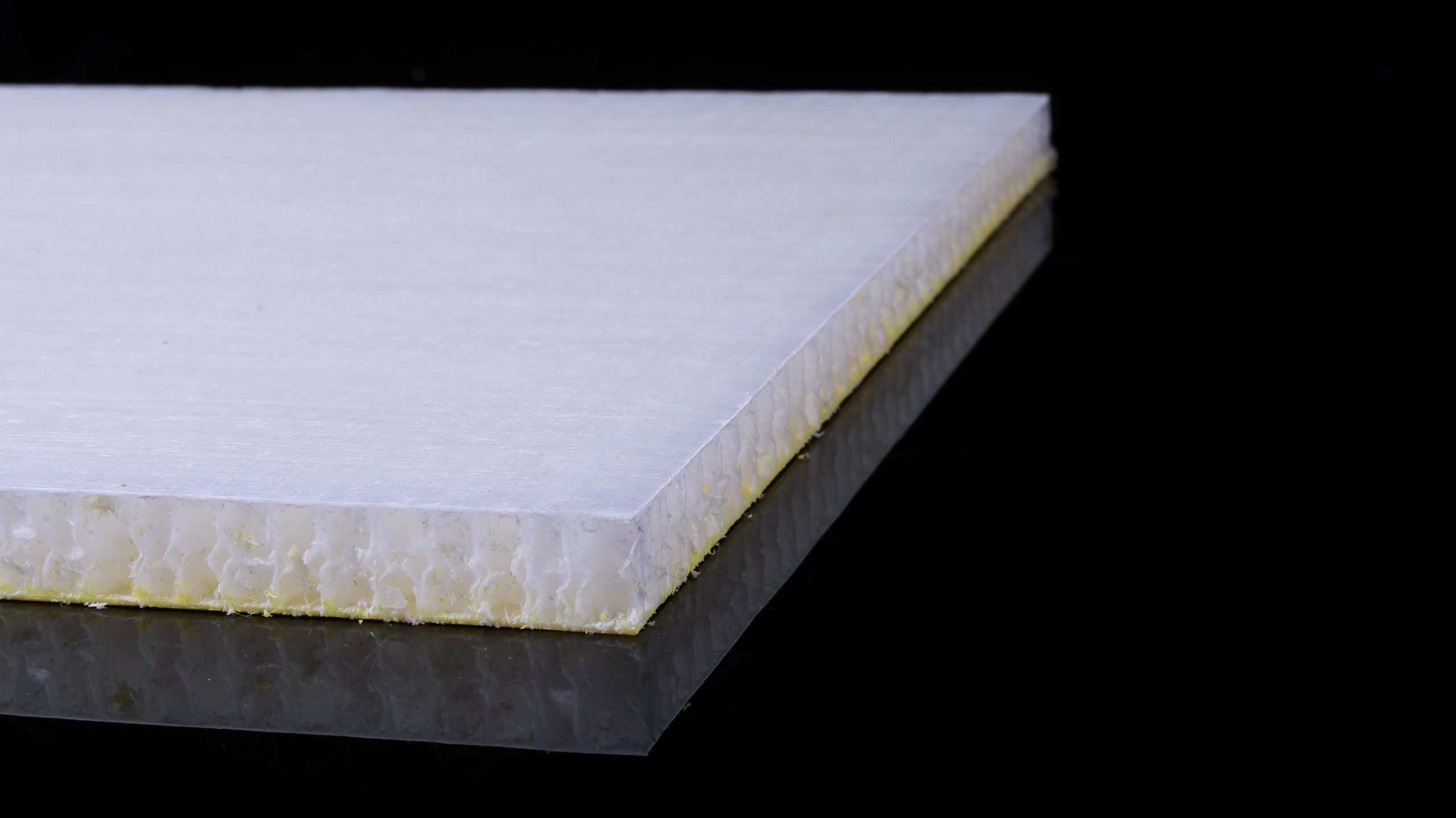
The question we get every week, and why it has no answer as asked
"What's the screw holding strength of your 20 mm panel?"
We get this from body builders, RV engineers and food truck fabricators constantly, and we cannot answer it as asked — not because we are hiding data, but because the question has at least four different answers depending on what you are about to build:
| What you are actually doing | What resists the load | Governing property |
|---|---|---|
| Self-tapping screw into the face sheet only | Local skin tear and pull-through | Skin laminate, measured per ASTM D7332 |
| Potted insert in an excavated pocket | Core shear on the potting perimeter | Core shear strength (ASTM C273) × potting diameter × core thickness |
| Through-bolt with washers or backing plates | Core compressive crush under the washer | Core flatwise compression (ASTM C365) × washer area |
| Through-thickness compression tube, or a laminated-in hardpoint | The bolt itself | Fastener grade — core removed from the load path |
Same panel. Four completely different numbers, spanning more than an order of magnitude. A supplier who answers "our panel holds X pounds" without asking which of these four you mean is quoting a number that will not survive your first field failure.
This article gives you the equation for each case, worked for our own published core properties, plus an honest plywood baseline computed from the USDA Wood Handbook so you can see exactly where a composite panel loses to plywood and where it wins. If you have not yet chosen how to cut and seal the panel, start with our guide to cutting, joining and fastening composite panels and come back here for the load numbers.
The four failure modes, straight from the design handbook
The most complete public treatment of fasteners in sandwich panels is ECSS-E-HB-32-22A, the ESA/ECSS Insert design handbook (20 March 2011). It was written for spacecraft, but the mechanics are identical in a refrigerated truck body — same sandwich, same insert, larger tolerances.
Its Table 10-1 lists the failure modes of an insert joint, and the handbook's own summary sentence is the one worth memorising:
> "Generally, the failure occurs in the core by shear stresses under out-of-plane loads and in the face sheet under in-plane loads."
Grouped by component:
- Core — shear failure (out-of-plane tension or compression); tension failure underneath the potting; compression failure underneath the potting.
- Potting compound — tensile failure underneath the insert; insert tear-out; adhesion failure between insert and potting.
- Adhesion — core-to-face-sheet disbond.
- Face sheet — tension, bearing, dimpling, wrinkling and shear-out failures, all under in-plane load.
The governing equation, worked for a 20 mm panel
For an out-of-plane load, the core carries the load as shear on a cylindrical surface around the potted or bearing region. The conservative first-pass form is:
P = τ_c × 2π × r_p × cwhere τ_c is core shear strength (MPa), r_p is the effective potting or bearing radius (mm), and c is core thickness (mm). ECSS recommends applying a 1.15 fitting factor to all potted inserts, so your design load is P / 1.15.
Our extruded PP honeycomb core at 80 kg/m³ has a published shear strength of 0.6–1.2 MPa to ASTM C273. Running the equation on a 20 mm core gives:
| Potting / bearing diameter | Shear area | Capacity at 0.6 MPa | Capacity at 1.2 MPa |
|---|---|---|---|
| 16 mm | 1,005 mm² | 603 N (136 lbf) | 1,206 N (271 lbf) |
| 25 mm | 1,571 mm² | 943 N (212 lbf) | 1,885 N (424 lbf) |
| 40 mm | 2,513 mm² | 1,508 N (339 lbf) | 3,016 N (678 lbf) |
| 60 mm | 3,770 mm² | 2,262 N (509 lbf) | 4,524 N (1,017 lbf) |
Read the first column again. Going from a 16 mm potted pocket to a 60 mm one multiplies capacity by 3.75 — on the same panel, with the same core, at zero material cost. Going from a 20 mm core to a 30 mm core at 25 mm potting takes you from 943 N to 1,414 N at 0.6 MPa: a real gain, but you paid for 50% more core thickness to get 50% more load.
Two honesty notes, because a number you cannot reproduce is worthless:
- This is the uniform-shear simplification. The full ECSS treatment distributes shear as τ(r) = PK / (2π·r·t_c) and solves with Bessel functions for the core-to-skin stiffness ratio. Use the simple form to size the joint and choose the hardpoint, then confirm by test.
- The formula uses core shear strength at your core thickness, and shear strength declines as cores get thicker. We cover that effect in the honeycomb core specification guide — do not lift a shear value measured on a 12 mm sample and apply it to a 40 mm panel.
The counter-intuitive part: thicker skins buy you almost nothing
When a fastener pulls out of a panel, the reflex on every shop floor we have visited is the same: *heavier panel, thicker skin, longer screw.*
ECSS ran the sensitivity study. For a partially potted D17 insert in a 3/16-0.001P aluminium core, 30 mm thick with 0.3 mm face sheets, the ultimate out-of-plane capability is 3,784 N (851 lbf), failing in core shear. Increase each input by 5% and measure the gain:
| Input increased by 5% | Gain | Share of total improvement |
|---|---|---|
| Potting diameter (11.42 → 11.99 mm) | +190 N (+5.02%) | 32% |
| Core shear strength (1.46 → 1.53 MPa) | +189 N (+4.99%) | 32% |
| Core thickness (30.0 → 31.5 mm) | +175 N (+4.62%) | 29% |
| Face sheet thickness (0.30 → 0.32 mm) | +41 N (+1.08%) | 7% |
The handbook's own conclusion: *"the face sheet thickness, f, has very limited influence on out-of-plane capacity when the failure mode is core shear or core tension."* In the companion case that fails in core tension (a D14 insert, Pult = 6,258 N / 1,407 lbf), potting diameter is even more dominant at 50% of the available improvement.
This flips the usual sales conversation, so let us be blunt about it: if your fastener is pulling out, you probably do not need to buy a heavier panel from us. You need to spread the load over a larger diameter. A 25 mm fender washer instead of a standard M8 washer costs about $0.10 and does more for your joint than upgrading the skin from 0.5 mm to 0.7 mm across the whole body. Bonded-fastener makers reach the same conclusion from the other direction — bigHead notes that "larger Head sizes can increase the load to failure rating," and that surface bonding avoids cutting the reinforcing fibres at all.
Where a heavier panel genuinely does help is core shear strength and thickness — together 61% of the sensitivity. That is a legitimate spec change, and it is the one to make when your loads are distributed rather than concentrated at a few hardpoints. See the honeycomb vs foam core comparison for how the core families rank on shear at a given density.
Same insert, same panel, different strength: the cell registration problem
Here is the detail that makes a single catalogue number impossible, and it is one almost nobody outside aerospace has written down.
The pull-out capacity of a potted insert depends on how many single cell walls fail, not on how many cells you filled with potting compound. ECSS published the test evidence: two pottings with the same 16 filled cells produced 24 and 26 failing cell walls depending on where the insert centre landed relative to the hexagonal grid. A potting with 17 filled cells produced only 24.
The handbook states it plainly: *"It cannot be concluded that a great number of filled core cells gives better load-carrying capability. The critical parameter is the number of failing single cell walls."* And: *"it is impossible to consider in advance how much bigger the real potting shape is"* — which is why the analysis uses semi-empirical potting radius formulae rather than a geometric one.
Translate that to a truck body shop. The cell grid is invisible once the panel is laminated. Your operator drills where the drawing says, and the hole lands wherever it lands relative to the hexagons. You get roughly 8% scatter in capacity from hole position alone, before you account for core density tolerance — and commercial-grade core density tolerance is typically ±10% or worse, which flows straight through to shear strength.
Three rules follow:
- Design to the minimum, not the average. ECSS itself publishes two curves, minimum insert capability and average insert capability, and expects you to use the minimum for flight hardware. Use the minimum for anything that holds a person, a door or a load.
- Prefer a larger potting diameter over a tighter tolerance. A bigger pocket averages over more cells, which reduces the scatter as well as raising the mean.
- Never single-point a moment. ECSS calls it good design practice to carry bending moments as out-of-plane force on pairs of inserts, and to avoid torsion on a single insert entirely — use coupled inserts. An awning bracket on one insert is a warranty claim.
The plywood baseline, computed honestly
Composite panel suppliers love to skip this comparison. We will run it, using the primary source every wood engineer uses: the USDA Forest Service Wood Handbook, Chapter 7, Fastenings.
Ultimate withdrawal load for a wood screw in the side grain of seasoned wood (Eq. 7-10b):
p = 15,700 × G² × D × L (lb, inch units)where G is specific gravity at 12% moisture content, D is shank diameter (in.) and L is the threaded penetration (in.). For a #10 screw (D = 0.190 in.) in Douglas-fir plywood (G ≈ 0.50):
| Plywood | Threaded penetration | Solid-wood equation | Plywood penalty (15–30%) | Ultimate pull-out |
|---|---|---|---|---|
| 12 mm (1/2 in.) | 0.40 in. | 298 lbf | −15 to −30% | 209–254 lbf (0.93–1.13 kN) |
| 18 mm (3/4 in.) | 0.62 in. | 462 lbf | −15 to −30% | 324–393 lbf (1.44–1.75 kN) |
The penalty is the Wood Handbook's own figure — withdrawal resistance of plywood is "15% to 30% less than that of solid wood of the same thickness," and it notes that "the withdrawal resistance per unit length of penetration decreases as the number of plies per unit length increases." Two more clauses worth knowing: screws in end grain average 75% of side-grain values, and sheet metal (type A tapping) screws run about 10% higher than wood screws of comparable size, with the ratio between 1.05 in light woods and 1.16 in dense ones.
Now compare honestly against the composite options on a 20 mm panel:
| Joint on a 20 mm composite panel | Ultimate out-of-plane capacity | vs 12 mm plywood (209–254 lbf) |
|---|---|---|
| Self-tapping screw into 0.5 mm skin only | Not calculable from panel properties — measure per ASTM D7332 | Loses badly. Roughly one thread of engagement. Treat as non-structural. |
| Ø25 mm potted insert | 212–424 lbf | Comparable to better |
| Ø40 mm potted insert | 339–678 lbf | 1.6–2.7× |
| Ø60 mm potted insert or laminated hardpoint | 509–1,017 lbf | 2.4–4× |
| Through-thickness compression tube | Fastener-limited | Not comparable — core is out of the load path |
The conclusion is the one we tell customers before they place an order: a screw driven into a bare composite skin is weaker than the same screw in plywood, and no core upgrade fixes it. A designed hardpoint in the same panel beats plywood by two to four times at a fraction of the weight. The composite panel is not the variable. The joint is. If you are still weighing the material itself, the numbers are in our PP honeycomb panel vs plywood comparison.
Clamp-up is the failure nobody designs for
Even a correctly sized through-bolt destroys panels if you torque it like steel. The core under the washer sees pure compression, and our PP honeycomb core's flatwise compressive strength is 1.5–2.0 MPa to ASTM C365. Multiply by washer bearing area:
| Washer / plate under the bolt | Bearing area | Load at onset of core crush (1.5 MPa) |
|---|---|---|
| M8 standard flat washer, Ø16 mm | 146 mm² | 218 N (49 lbf) |
| M8 fender washer, Ø25 mm | 435 mm² | 653 N (147 lbf) |
| M8 backing plate, Ø40 mm | 1,201 mm² | 1,802 N (405 lbf) |
Forty-nine pounds. A standard washer begins crushing the core at a clamp load an assembler generates with two fingers on a cordless driver. This is why panels come back from the field with dimpled skins around every bolt, and why the fix is a compression tube — a metal sleeve through the full core thickness, so torque reacts steel-to-steel and the core never sees the clamp load.
Specify torque as a number on the drawing, not "tighten." And note that torque capacity scales with density: the Wood Handbook's particleboard stripping-torque relation, T = 27.98 + 1.36X (in-lb, X in lb/ft³), exists precisely because low-density substrates strip before the joint is tight. Honeycomb cores are lower density than particleboard.
Six hardpoint details that work on vehicle bodies
- Through-bolt with backing plates on both faces. Cheapest structural option. Limited by core crush, so size the plate from the table above, not from the bolt.
- Compression tube / through-thickness insert. The only option that removes the core from the load path entirely. Use it for door hinges, jack points, seat mounts and anything torqued to a spec.
- Partially or fully potted insert. Best strength-to-neatness ratio when only one face is accessible. Capacity from the core-shear equation; control vent perforation and potting viscosity or you will get the rare-but-ugly potting failures.
- Bonded surface fastener. Nothing is drilled, so no reinforcing fibres are cut. Excellent for light, distributed attachments — trim, conduit, panel-to-frame studs. Capacity is adhesive-limited and needs a clean, flame- or plasma-treated surface on polypropylene skins.
- Laminated-in hardpoint. A plywood, HDPE or aluminium block replacing the core locally, bonded in during panel lamination. This is the strongest and cheapest solution per hardpoint — but only if you tell us the locations before we build the panel. We cannot add it after lamination.
- Edge closure or extruded rail. For continuous loads — E-track, door frames, roof rails — stop trying to make point fasteners work and bond a rail into the panel edge. Our sandwich panel construction guide covers edge detailing.
What to put on the drawing, and what to ask your panel supplier
Five numbers turn "how strong is your panel" into a specification we can actually quote and test:
- Load per hardpoint, with direction — out-of-plane tension, in-plane shear, or a moment with the arm length.
- Hardpoint locations and quantity on a panel layout, so laminated-in blocks can be placed during production.
- Fastener you intend to use — thread, grade, head style, and installation torque.
- Required margin — and whether you are designing to minimum or average allowables.
- Service environment — washdown, freeze-thaw, vibration cycles. Cyclic pull-out is a different number from static.
- What is your core's ASTM C273 shear strength, and at what sample thickness was it measured?
- What is the density tolerance on the core grade you will actually ship?
- Do you publish minimum insert allowables, or only average?
- Will you witness-test my fastener in your panel and give me the load-displacement curve?
- Can you laminate hardpoints at my locations, and what is the MOQ for that?
Frequently Asked Questions
What is the pull-out strength of a screw in a composite sandwich panel?
There is no single value, because four different failure modes can govern. A self-tapping screw into a 0.5 mm face sheet engages roughly one thread and fails by skin pull-through — treat it as non-structural and measure it per ASTM D7332 if you must use it. A Ø25 mm potted insert in a 20 mm PP honeycomb panel calculates to 212–424 lbf (943–1,885 N) using core shear of 0.6–1.2 MPa, and a Ø60 mm hardpoint reaches 509–1,017 lbf. Always apply the ECSS 1.15 fitting factor and confirm by test.
Does a thicker face sheet increase fastener pull-out strength?
Barely. ECSS-E-HB-32-22A's sensitivity study found that a 5% increase in face sheet thickness raised out-of-plane capability by only 1.08% — 7% of the total available improvement — when the failure mode is core shear or core tension. Potting diameter and core shear strength each contributed 32%, and core thickness 29%. If a joint pulls out, widen the load-spreading diameter before you thicken the skin.
Which standard tests fastener pull-through in composites?
ASTM D7332/D7332M, Standard Test Method for Measuring the Fastener Pull-Through Resistance of a Fiber-Reinforced Polymer Matrix Composite. It records the force-displacement response as a fastener is pulled perpendicular through a composite plate. Procedure A varies the loading bar spacing to hole diameter ratio; Procedure B varies the clearance hole to fastener hole diameter ratio. Report hole and fastener diameter, head diameter, diameter-to-thickness ratio, fastener torque, countersink geometry and support fixture — pull-through numbers are meaningless without them. Core shear properties come separately from ASTM C273, and core compression from ASTM C365.Is a composite panel weaker than plywood for holding screws?
For a bare screw, yes. Using the USDA Wood Handbook equation p = 15,700 G²DL, a #10 screw in 12 mm Douglas-fir plywood withdraws at roughly 209–254 lbf after the 15–30% plywood penalty, and a screw in a thin composite skin cannot match that. For a designed joint, no — a Ø40–60 mm potted insert or laminated hardpoint in the same 20 mm composite panel reaches 339–1,017 lbf, two to four times the plywood value, at 60–70% less weight. The comparison is about the joint, not the panel.
Why do bolts dimple the skin around every fastener on my panels?
You are crushing the core under the washer. With a flatwise compressive strength of 1.5–2.0 MPa, a standard M8 flat washer (Ø16 mm, 146 mm² bearing area) starts crushing the core at about 218 N (49 lbf) of clamp load — far below what a cordless driver produces. Fit a Ø25–40 mm fender washer or backing plate to raise that to 653–1,802 N, or fit a through-thickness compression tube so the torque reacts steel-to-steel and never loads the core.
Can you add mounting hardpoints to a panel after it is made?
Potted inserts and through-bolted backing plates, yes — those are post-production operations, and we will tell you the achievable capacity for your core and thickness. Laminated-in hardpoints (a plywood, HDPE or aluminium block replacing the core locally) must be placed during lamination, so send the hardpoint layout with your enquiry. It is the strongest and lowest-cost option per point, and it is the one most customers discover they wanted after the panels shipped.
Do inserts in the same panel all have the same strength?
No, and the scatter is larger than most engineers expect. Capacity depends on the number of honeycomb cell walls that fail, not the number of cells filled with potting. ECSS test data shows two pottings filling the same 16 cells failing 24 and 26 cell walls depending on where the insert landed relative to the hexagonal grid, while a 17-cell potting failed only 24. Since the cell grid is invisible in a finished panel, design to minimum allowables, use the largest practical potting diameter, and carry moments on pairs of inserts rather than one.
Related Guides
- Cutting, Joining and Fastening Composite Panels
- Honeycomb Core Specification: Cell Size, Density and Ribbon Direction
- Honeycomb Core vs Foam Core Sandwich Panels
- Sandwich Panel Construction: Cores, Skins and Bonding
- PP Honeycomb Panel vs Plywood Comparison
- Trailer Wall Panels for Enclosed Cargo
- Truck Body Composite Panels and Payload
- Composite Panel Price Guide 2026
Send Us the Joint, Not Just the Panel Size
Tell us the load per hardpoint, the direction, the fastener you plan to use and where the mounts go. We will come back with a hardpoint recommendation, the calculated capacity, and — if you send us your fastener — a witness pull-out test in the exact panel build you are buying.
Hardpoint-laminated panels from 100 m² MOQ, 15–20 day lead time, FOB Shanghai or Ningbo.
Request a Quote | PP Honeycomb Panels | Sandwich Panels | WhatsApp Us
Sources: ECSS-E-HB-32-22A, *Space engineering — Insert design handbook*, ESA-ESTEC Requirements & Standards Division, 20 March 2011 (Table 10-1 failure modes; §10.9.2.4 potting diameter and cell-wall correlation; Tables 12-4 and 12-5 sensitivity analysis; 1.15 fitting factor). USDA Forest Service, *Wood Handbook*, Chapter 7 "Fastenings" (Eq. 7-10b wood screw withdrawal; Eq. 7-11b particleboard stripping torque; plywood withdrawal penalty; end-grain and tapping-screw ratios). ASTM D7332/D7332M (fastener pull-through resistance of FRP composites), ASTM C273 (shear properties of sandwich core materials), ASTM C365 (flatwise compressive properties of sandwich cores). HOTECH published core specifications and production data, 2026.