Why Weight Matters More in Vans Than in Any Other Vehicle
Weight management in a van conversion is not optional — it is a hard legal and engineering constraint. A standard Mercedes Sprinter 3500 has a gross vehicle weight rating (GVWR) of 5,000 kg and a curb weight of approximately 2,800 kg. That leaves 2,200 kg for the conversion, passengers, cargo, water tanks, batteries, and everything else.
A full interior build-out — walls, ceiling, floor, cabinetry, bed platform, kitchen — can consume 400-800 kg of that budget if built with traditional plywood and hardwood. Switch the panel materials to PP honeycomb composites and that number drops to 150-350 kg, freeing 250-450 kg for payload, water, batteries, or simply staying under the GVWR.
This is not a theoretical concern. Overweight vehicles face:
- Legal penalties in most jurisdictions (fines, vehicle impoundment)
- Insurance voidance if involved in an accident while overweight
- Accelerated wear on brakes, suspension, tires, and drivetrain
- Higher fuel consumption — roughly 1-2% more fuel per 100 kg of extra weight
Panel Materials Compared: The Complete Matrix
Here is every panel material commonly used in van conversions and RV construction, compared across the metrics that actually matter for vehicle applications.
| Material | Weight (kg/m2) | Thickness Range | Water Absorption | R-Value (per 25mm) | Temp Range | Mold Resistant | Recyclable | Cost (USD/m2) |
|---|---|---|---|---|---|---|---|---|
| PP Honeycomb (PET face) | 1.5-3.0 | 8-50 mm | < 0.1% | R-1.2 to R-1.5 | -40 to +80 C | Yes | 100% | $10-22 |
| CFRT Honeycomb Panel | 2.0-3.5 | 10-40 mm | < 0.1% | R-1.0 to R-1.3 | -40 to +80 C | Yes | 100% | $25-45 |
| Luan Plywood | 4.0-6.0 | 3-18 mm | 10-20% | R-0.6 to R-0.8 | -20 to +60 C | No | No | $5-12 |
| Birch Plywood | 6.0-9.0 | 6-24 mm | 8-15% | R-0.6 to R-0.8 | -20 to +60 C | No | No | $8-18 |
| Aluminum Composite (ACM) | 3.5-5.5 | 3-6 mm | 0% | R-0.05 | -50 to +80 C | Yes | Partial | $15-30 |
| XPS Foam Board | 0.8-1.5 | 20-100 mm | 0.3-1.0% | R-5.0 | -50 to +75 C | Yes | No (thermoset) | $8-15 |
| EPS Foam Board | 0.3-0.8 | 20-100 mm | 1.0-3.0% | R-4.0 | -50 to +70 C | Yes | No | $4-8 |
| FRP (Fiberglass Sheet) | 3.5-5.0 | 1-3 mm | 0.5-2.0% | R-0.1 | -30 to +120 C | Yes | No (thermoset) | $15-25 |
| Foam-Core Sandwich | 2.5-4.5 | 10-50 mm | 1-5% (foam dependent) | R-2.0 to R-4.0 | -30 to +70 C | Depends | No | $18-35 |
Two materials stand out from this table. PP honeycomb panels offer the best overall balance of weight, moisture resistance, structural rigidity, and cost for wall and ceiling applications. XPS foam board offers the best insulation value per millimeter but has no structural capacity — it needs a structural panel behind it or around it.
The worst performer for van and RV applications is the one that most people start with: luan plywood. It is cheap and easy to cut, but it absorbs moisture like a sponge, supports mold growth, and adds unnecessary weight. We will cover exactly why below.
Wall Panels: Where Condensation Kills Plywood
The walls of a van conversion are the highest-risk surfaces for moisture damage. Here is why:
A camper van with two occupants generates approximately 1-2 liters of moisture per night from breathing alone. Add cooking, showering (if equipped), and wet gear, and the daily moisture load can reach 3-4 liters. In cold weather, this moisture condenses on the coldest available surface — which is usually the inside face of the van's metal shell, and any panel material in contact with it.
Plywood wall panels in this environment absorb moisture continuously. Within one winter season of regular use, luan plywood can reach 15-20% moisture content — well above the 20% threshold where fungal growth begins. The result is mold behind the wall panels, a musty smell, and eventual delamination. Many van conversion teardowns after 2-3 years of use show extensive mold growth behind plywood panels that looked fine from the front.
PP honeycomb panels eliminate this failure mode. Polypropylene does not absorb water at the molecular level — our panels test below 0.1% water absorption per ASTM D570 after 24-hour immersion. Condensation beads on the panel surface and drains away. There is no organic material to support mold or fungal growth.Recommended Wall Panel Build-Up
For van conversion wall panels, we recommend the following layered construction:
Total wall thickness: 30-50 mm. Total added weight: 2.5-5.0 kg/m2 (vs 7-10 kg/m2 for a plywood-based wall).
This build-up handles the worst-case moisture scenario: cold weather, two occupants, cooking, no ventilation. The closed-cell foam prevents condensation on the metal. The PP honeycomb panel does not absorb any moisture that does get past the foam. And the whole assembly can be removed for inspection or repair because it is not permanently bonded.

Floor Panels: The Case for CFRT
Van and RV floors face a different challenge than walls. The primary concerns are:
- Point load resistance — standing on one foot, table legs, furniture mount points
- Impact resistance — dropped objects, sliding cargo, wheelchair ramps
- Abrasion resistance — foot traffic, shoes, moving items in and out
- Water resistance — spills, tracked-in rain and mud, pet water bowls
CFRT panels deliver:
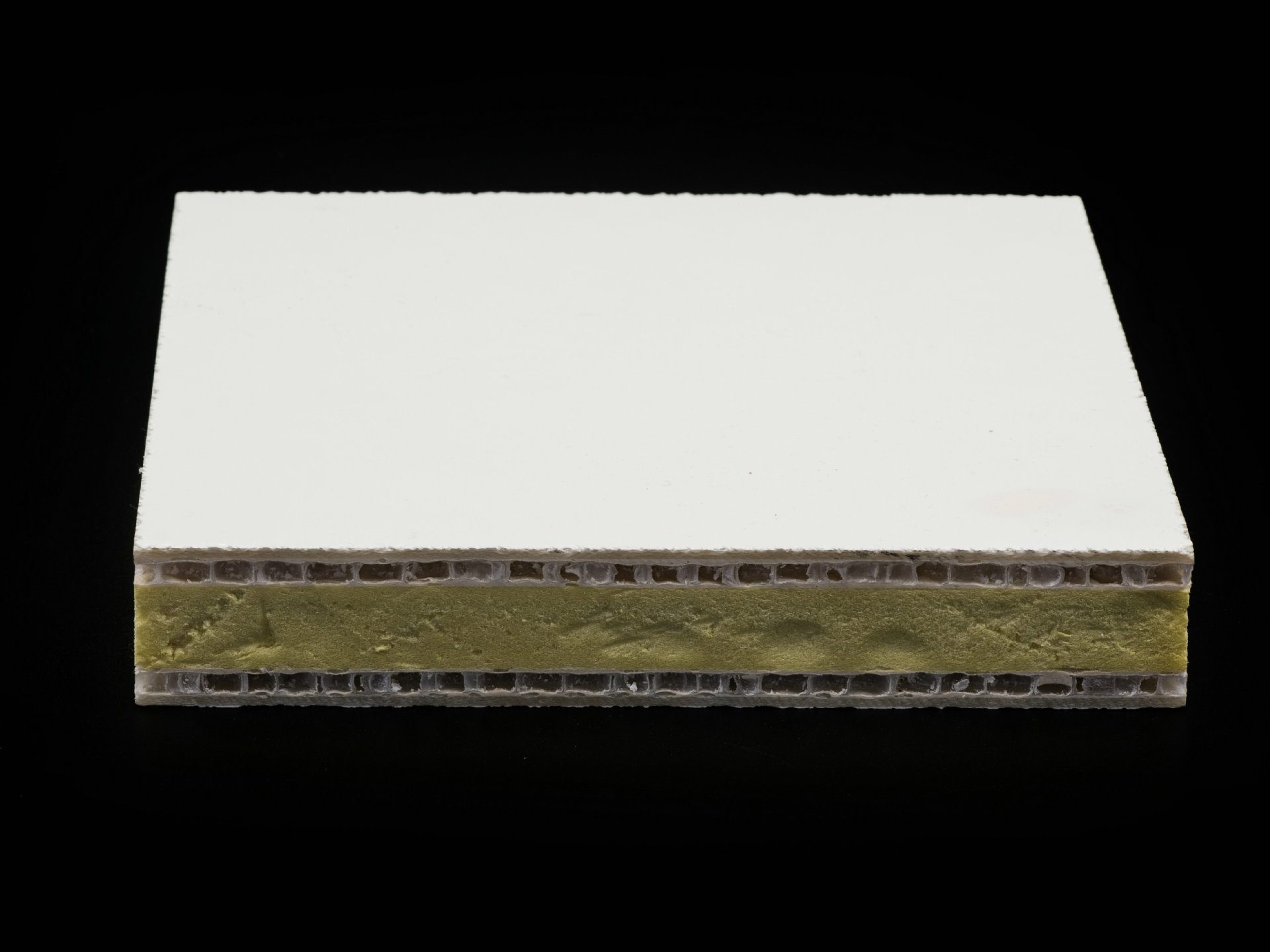
- 40-60% higher flexural strength than standard GF-face PP honeycomb (25-50 MPa vs 15-35 MPa)
- Superior impact resistance — the continuous fiber face sheets distribute point loads over a larger area
- Anti-slip surface available (textured black face sheet)
- Same zero water absorption as standard PP honeycomb
See our full CFRT panel guide and CFRT product page for detailed specifications.
Ceiling Panels: Maximum Weight Saving
The ceiling is the easiest panel to lightweight because structural loads are minimal — the ceiling panel primarily needs to be rigid enough not to sag under its own weight, provide a clean interior surface, and ideally contribute some insulation and acoustic dampening.
Best choice: PP honeycomb panel, 8-12 mm, PET non-woven face sheet.At 1.5-2.0 kg/m2, an 8 mm PP honeycomb ceiling panel is lighter than any plywood option by a factor of 3-4x. The hexagonal cell structure provides natural acoustic dampening — significantly quieter than bare metal or thin plywood against rain, road noise, and vibration.
For ceiling panels, we recommend the PET (polyester) non-woven face sheet rather than glass fiber. PET face sheets are lighter, softer to the touch, and provide a clean white or grey surface that can be left exposed without additional finishing. They are also easier to cut to fit around ceiling-mounted items (lighting, fans, roof hatches).
Installation tip: PP honeycomb ceiling panels can be adhered directly to closed-cell foam insulation using a polyurethane or MS polymer adhesive. No mechanical fasteners are needed for panels up to 1200 mm wide between support points. For wider spans, use lightweight aluminum furring strips every 600 mm.Insulation Value: PP Honeycomb vs Dedicated Insulation
A common question from van builders: "Can PP honeycomb panels replace both the wall panel and the insulation?"
The honest answer: partially, but not completely in cold climates.
A 20 mm PP honeycomb panel has a thermal conductivity of 0.06-0.08 W/mK, giving it an R-value of approximately R-1.2 to R-1.5 per 25 mm of thickness. That is better than plywood (R-0.6 to R-0.8) and much better than aluminum composite panels (R-0.05), but not as good as dedicated insulation like XPS foam (R-5.0) or polyiso (R-6.5).
For three-season use in temperate climates, a 20-25 mm PP honeycomb panel may provide sufficient insulation on its own. For four-season use or cold-climate winter camping, you still need a dedicated insulation layer (typically 20-50 mm of XPS, Armaflex, or Thinsulate) between the metal shell and the PP honeycomb interior panel.
The advantage of PP honeycomb over plywood in this situation is that the PP panel does not compromise the insulation system. Plywood in contact with insulation traps moisture between the two layers, degrading the insulation's R-value and promoting mold growth. PP honeycomb does not absorb or trap moisture, so the insulation performs as designed over the full life of the vehicle.
Weight Budget Calculator: Panels in a Typical Van Conversion
Here is a real-world weight comparison for a mid-size van conversion (Mercedes Sprinter 144" WB or equivalent), using approximately 25 m2 of wall panels, 6 m2 of floor, and 8 m2 of ceiling:
| Component | Plywood Build (kg) | PP Honeycomb Build (kg) | Weight Saved (kg) |
|---|---|---|---|
| Wall panels (25 m2) | 25 x 5.5 = 137.5 | 25 x 2.0 = 50.0 | 87.5 |
| Floor panels (6 m2) | 6 x 10.0 = 60.0 | 6 x 3.0 = 18.0 (CFRT) | 42.0 |
| Ceiling panels (8 m2) | 8 x 4.0 = 32.0 | 8 x 1.5 = 12.0 | 20.0 |
| Total panels | 229.5 kg | 80.0 kg | 149.5 kg |
This calculation does not include cabinetry, bed platform, and furniture — all of which can also use PP honeycomb panels as a lightweight plywood substitute, potentially saving another 50-100 kg in a full build.
Sourcing Panels for Van and RV Builds
For professional van conversion companies and RV manufacturers buying panels in production quantities, we supply:
Standard panels (MOQ 200 m2):- PP honeycomb wall panels: 10 mm, 12 mm, 15 mm, 20 mm with PET or GF face sheets
- CFRT floor panels: 15 mm, 20 mm with anti-slip or smooth face
- PP honeycomb ceiling panels: 8 mm, 10 mm with white PET face
- Custom panel sizes up to 2500 x 6000 mm
- CNC-cut panels with pre-cut holes for wiring, plumbing, and fixtures
- Custom face sheets: decorative wood-grain film, colored PET, aluminum foil vapor barrier
- Edge-banding and edge-sealing
For DIY van converters buying smaller quantities, we recommend contacting our sales team about partnering with a local distributor or joining a group buy with other van builders to meet the 200 m2 MOQ.
Frequently Asked Questions
What is the lightest wall panel material for a van conversion?
PP honeycomb panels at 1.5-3.0 kg/m2 are the lightest rigid panel material suitable for van conversion walls. XPS foam board is lighter (0.8-1.5 kg/m2) but lacks structural rigidity and cannot serve as a finished wall surface on its own. Luan plywood at 4-6 kg/m2 and birch plywood at 6-9 kg/m2 are 2-4x heavier than PP honeycomb for equivalent structural performance.
Will PP honeycomb panels get mold in a van?
No. Polypropylene absorbs less than 0.1% water by weight and contains no organic material that can support fungal or mold growth. This is the primary advantage of PP honeycomb over plywood for van conversions, where condensation is unavoidable in cold weather. Plywood panels in the same environment regularly develop mold within 1-2 seasons of use.
Can I screw into PP honeycomb panels?
Yes, but with a caveat. Self-tapping screws into PP honeycomb core have lower pull-out strength than screws into solid plywood. For light loads (attaching trim, lightweight shelves), direct screwing is fine. For heavier loads (cabinet mounting points, tie-down points), use bonded threaded inserts, through-bolts with backing plates, or adhesive-bonded hardware. This is standard practice for all sandwich panel materials, not unique to PP honeycomb.
How do I cut PP honeycomb panels for a van conversion?
Use a standard circular saw with a fine-tooth carbide blade (60+ teeth), a jigsaw with a metal-cutting blade, or a multi-tool for detail cuts. PP honeycomb cuts cleaner than plywood — no splintering, no grain tear-out. Wear a dust mask as with any panel cutting. For curved cuts to match van body contours, a jigsaw or reciprocating saw works well. Thin panels (8-10 mm) can be cut with heavy-duty shears or a utility knife scored and snapped.
What adhesive should I use to bond PP honeycomb panels in a van?
Polyurethane adhesives (Sikaflex 252, 3M 5200) and MS polymer adhesives (Bostik MSR, Soudaseal 270 HS) both bond well to PP honeycomb panels. Clean the bonding surface with isopropanol first. Avoid silicone-based adhesives — they do not bond well to polypropylene. For structural bonds, roughen the face sheet surface with 80-grit sandpaper before applying adhesive. Contact adhesive (spray) works for non-structural applications like ceiling panel installation.
Related Guides
- PP Honeycomb Panel vs Plywood: Weight, Strength & Cost Comparison
- Camper Siding Panels: FRP vs Aluminum vs Composite
- CFRT Panel Complete Guide
- PP Honeycomb Board Manufacturer China: Custom Sizes & OEM
- RV Interior Wall Paneling Options
Get Panels for Your Van or RV Build
HOTECH manufactures PP honeycomb panels and CFRT panels for van conversion companies and RV OEMs worldwide. We supply from raw polypropylene pellets through to finished, cut-to-size panels — 31 patents, ISO 9001:2015 certified, dual production bases in China and Malaysia.
Tell us your vehicle model, interior layout, and annual build volume. We will provide a panel specification, weight savings analysis, and FOB pricing.
Sources: ASTM D570 (water absorption), ASTM C365 (compressive properties of sandwich cores), ISO 178 (flexural properties), Sprinter 3500 GVWR specifications, HOTECH production test data (2026).![PP Honeycomb Panel — Properties, Applications & How It's Made [2026]](/images/products/pp-honeycomb-panel.jpg)