Quick Answer
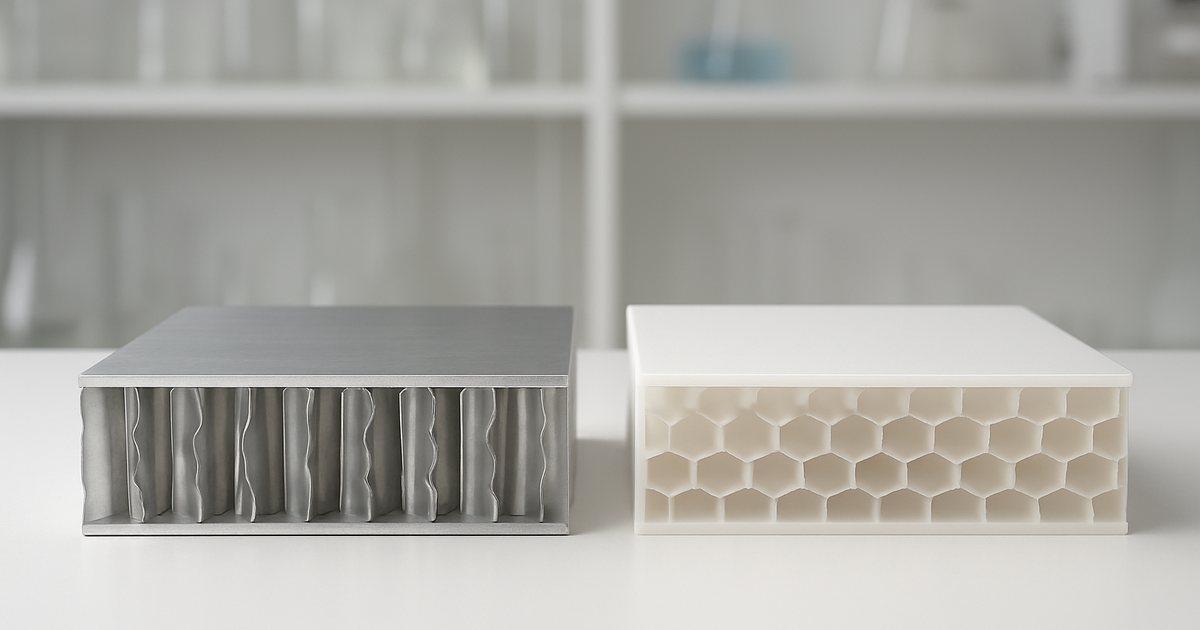
PP honeycomb panels weigh 3-5 kg/m² versus 10-15 kg/m² for drywall-on-stud construction, making them ideal for lightweight partition walls, stone-faced building facades, highway sound barriers, raised access floors, and cleanroom panels. They are waterproof, recyclable, and install faster than traditional methods because each panel is a single-layer structural element — no framing, no insulation fill, no multi-step assembly.
Construction Applications Overview
The construction industry is the third-largest market for PP honeycomb panels, behind vehicle manufacturing and logistics. Architects, builders, and fit-out contractors use them where light weight, fast installation, or moisture resistance are priorities.
| Application | Panel Thickness | Face Sheet | Weight (kg/m²) | Key Benefit |
|---|---|---|---|---|
| Interior Partition | 20-40mm | Painted fiberglass or HPL | 3-5 | 60% lighter than drywall, relocatable |
| Stone Facade | 15-25mm | 2mm natural stone veneer | 6-8 | 90% lighter than solid stone |
| Sound Barrier | 30-50mm | Perforated aluminum + solid | 4-7 | NRC 0.4-0.7, waterproof |
| Raised Floor Tile | 25-40mm | HPL or anti-static laminate | 5-8 | Lightweight, cable routing |
| Cleanroom Panel | 15-25mm | Smooth fiberglass or steel | 3-5 | Non-shedding, washable |
| Exhibition Wall | 10-15mm | Printed vinyl or fabric | 1.5-3 | Portable, reusable |
Lightweight Partition Walls
Traditional interior partitions use metal studs, drywall sheets, joint compound, and paint — a multi-trade process requiring framing carpenters, drywall installers, tapers, and painters. The finished wall weighs 10-15 kg/m² and is permanent (difficult to relocate without demolition).
PP honeycomb partition panels are single-layer elements that arrive pre-finished. Panels slot into floor and ceiling tracks, connect at joints with H-profiles, and are immediately ready for use. No wet trades, no drying time, no dust. The installed wall weighs 3-5 kg/m² — reducing structural load on the building by 60-70%.
For offices, hospitals, and commercial spaces that need flexible layouts, honeycomb partitions can be disassembled, relocated, and reused without damage. This makes them ideal for tenant fit-outs where the layout may change with each lease cycle.
Stone-Faced Facades
Natural stone facades are beautiful but heavy — 50-80 kg/m² for 20mm granite or marble. This weight demands heavy structural support, expensive anchoring systems, and limits stone use to lower floors on many buildings.
Stone-faced honeycomb panels solve this problem by bonding a thin stone veneer (2-3mm) to a PP honeycomb core. The resulting panel weighs only 6-8 kg/m² — roughly 90% lighter than solid stone. This enables stone facades on lightweight structures, high-rise curtain walls, and interior feature walls where solid stone would be impractical.
The honeycomb core also provides natural thermal insulation and vibration damping, improving the building envelope's energy performance compared to solid stone cladding.
At HOTECH, we produce stone-faced honeycomb panels with granite, marble, travertine, and slate veneers. Maximum panel size: 1,500 x 3,000mm.
Highway Sound Barriers
PP honeycomb panels with perforated face sheets make effective highway sound barriers. Sound energy enters through the perforations and is absorbed by viscous friction within the honeycomb cells. The sealed back face sheet prevents sound transmission through the panel.
Compared to concrete sound barriers (200-300 kg/m²) and metal barriers (15-25 kg/m²), PP honeycomb barriers weigh just 4-7 kg/m². This reduces foundation requirements, simplifies installation, and lowers transportation costs. The panels are corrosion-proof, maintenance-free, and last 20+ years in outdoor exposure.
Acoustic performance data from our 50mm perforated-face honeycomb panel tested per ISO 354:
| Frequency (Hz) | Absorption Coefficient |
|---|---|
| 250 | 0.30 |
| 500 | 0.55 |
| 1000 | 0.65 |
| 2000 | 0.70 |
| 4000 | 0.60 |
| NRC | 0.55 |
Raised Access Flooring
Data centers, server rooms, and modern offices use raised access flooring to route cables, HVAC ducts, and utilities beneath the floor surface. Conventional raised floor tiles use steel encased concrete or calcium sulfate — heavy materials that increase structural load requirements.
PP honeycomb raised floor tiles weigh 5-8 kg/m² versus 25-35 kg/m² for conventional tiles. For a 1,000 sqm data center, this saves 20-30 tonnes of floor weight — potentially enabling raised flooring on upper stories of buildings that were not designed for the additional load.
Our raised floor tiles feature HPL (high pressure laminate) or anti-static surfaces on the top face and a smooth fiberglass bottom face. They meet PSA MOB PF2 PS/SPU loading requirements for office environments.
Cleanroom and Hygienic Panels
Pharmaceutical manufacturing, food processing, and electronics assembly require walls that do not shed particles, resist chemical cleaning agents, and can be washed down regularly. PP honeycomb panels with smooth fiberglass or stainless steel face sheets meet these requirements while weighing 60-70% less than traditional cleanroom wall systems.
The polypropylene core is inert — it does not harbor bacteria, absorb moisture, or release particles. Face sheets are bonded thermally (no adhesive joints that could harbor contamination), and panel edges are sealed with food-safe silicone.
Frequently Asked Questions
How do PP honeycomb partitions compare to drywall on cost?
Material cost per m² is higher ($18-30 vs $8-12 for drywall). However, total installed cost is often comparable or lower because honeycomb partitions eliminate framing, taping, mudding, sanding, and painting labor. Installation is 3-5x faster. For relocatable partitions, the lifecycle cost is significantly lower because panels can be reused.
Can PP honeycomb panels support shelving and fixtures?
Yes. Heavy items require through-bolt connections with backing plates or inserts embedded in the honeycomb core. For light items (picture frames, paper towel dispensers), self-tapping screws into the face sheet and core provide adequate pull-out strength (800-1,200 N per fastener in 15mm panels).
Are PP honeycomb panels suitable for wet areas?
Absolutely. Polypropylene absorbs zero moisture, so PP honeycomb panels are ideal for bathrooms, kitchens, pool enclosures, and car wash facilities. Use sealed edge treatments and waterproof face sheets (smooth fiberglass, not uncoated PET).
What fire ratings do construction-grade panels achieve?
Our standard panels meet Class B1 (DIN 4102) and B-s2,d0 (EN 13501-1) fire classifications. FR-grade panels with flame-retardant PP achieve Class B (DIN 4102) and B-s1,d0. For applications requiring Class A (non-combustible), we offer aluminum-honeycomb-core panels with fiberglass face sheets.
How long do PP honeycomb panels last in outdoor applications?
With UV-stabilized face sheets, PP honeycomb panels last 15-20+ years in outdoor exposure. We test to ASTM G154 (accelerated UV weathering) and guarantee no significant degradation at 2,000 hours of exposure. For permanent outdoor installations like sound barriers, we recommend UV-stabilized fiberglass or aluminum face sheets.
Related Guides
- PP Honeycomb Panel: Properties, Applications & Manufacturing Guide
- Lightweight Honeycomb Panels: Engineering Guide
- Fire Ratings for Composite Panels: FMVSS 302 to EN 45545
- Sandwich Panel Construction: Core Materials, Skins & Bonding Methods
- Composite Panel Price Guide 2026
Build Lighter
Whether you need partition walls, facade panels, sound barriers, or cleanroom enclosures, PP honeycomb panels reduce weight 60-90% versus traditional materials. Contact us for specifications, samples, and project-specific engineering support.